Base
Hardened build
minimal ports, security patches applied at build time

open source container vulnerability scanning, ready to run and secured from first boot by cloudimg
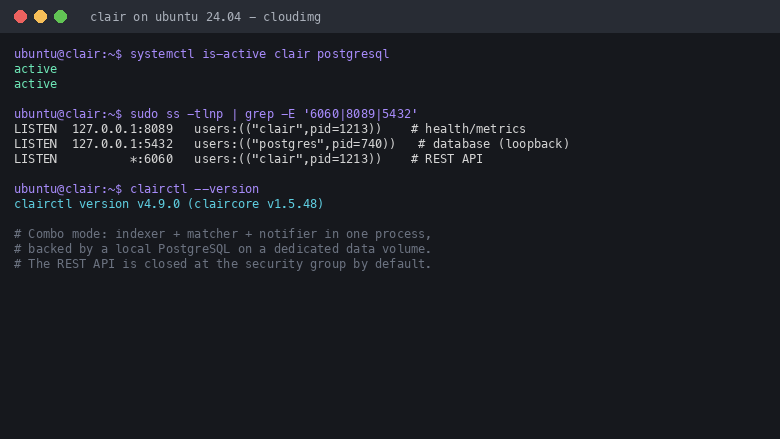
Clair performs static analysis of vulnerabilities in application containers. It indexes the package contents of a container image's layers and reports the known CVEs that affect them, so you can gate images before they are promoted, audit a registry, or answer what is vulnerable in what you are about to ship. This cloudimg image runs Clair in combo mode, with its indexer, matcher and notifier in a single process fronted by a REST API and the bundled clairctl tool, backed by a local PostgreSQL database, so a scanning API is answering within minutes of launch.
The cloudimg image is production ready from first boot: a strong PostgreSQL password is generated uniquely on every instance and never baked into the image, the vulnerability database sits on a dedicated, independently resizable data volume rather than the boot disk, the REST API is closed to the network by default, and every deployment is paired with a step by step guide and backed by 24/7 cloudimg support.
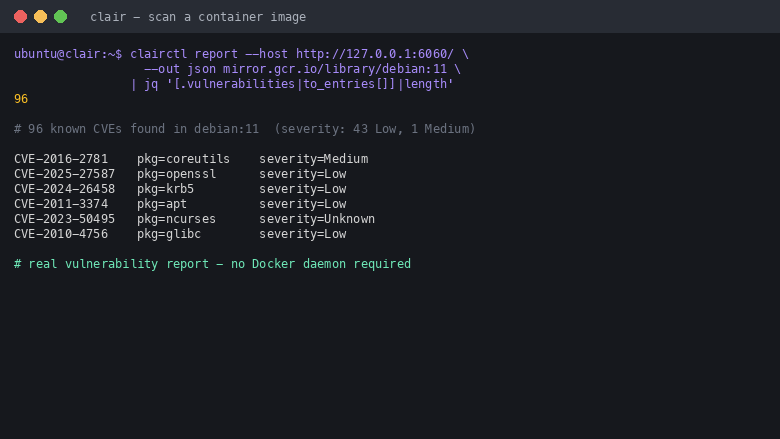
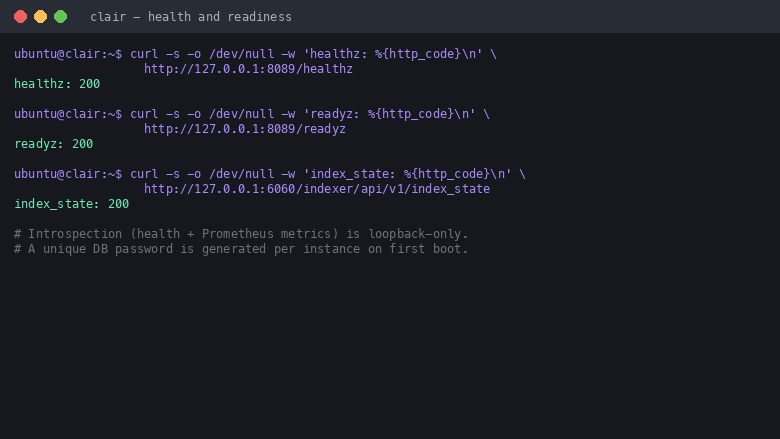
Real screenshots taken while testing this image against its deployment guide.
This is a repackaged open source software product wherein additional charges apply for cloudimg support services.
## Overview
Clair is an open source project for the static analysis of vulnerabilities in application containers. It indexes the package contents of a container image's layers and reports the known CVEs that affect them, so you can gate images in CI, audit a registry, or answer what is vulnerable in what you are about to ship. This AMI delivers Clair fully installed and running in combo mode on a local PostgreSQL backend - a container vulnerability scanning API answering within minutes of launch.
## Container Vulnerability Scanning
The Clair daemon runs the indexer, matcher, and notifier in a single combo process, fronted by a REST API and driven by the bundled clairctl command-line tool. Point clairctl at a container image and Clair pulls the manifest, indexes every layer's installed packages, matches them against continuously updated vulnerability data from distribution security trackers and public feeds, and returns a full vulnerability report. No container runtime or Docker daemon is required on the instance - unlike scanners that depend on a local Docker socket, Clair works entirely through registry APIs.
## Named Integrations
Clair integrates with container registries including Amazon ECR, Docker Hub, Quay, and GitHub Container Registry. For CI/CD pipelines, wire clairctl into Jenkins, GitLab CI, or any automation tool that can invoke a CLI or call a REST endpoint. Because Clair speaks standard registry protocols, any OCI-compliant registry is supported out of the box.
## Secure By Default
The REST API is unauthenticated by Clair's own default and the shipped security group opens only the SSH port, so the scanner is never exposed to the network until you deliberately open the API port behind your own access controls. A strong, unique database password is generated automatically on the first boot of every instance and written to a root-only credentials file - no shared secret is ever baked into the image.
## Production Storage Layout
The PostgreSQL data directory is placed on a dedicated, independently resizable EBS data disk rather than the operating system root volume. The vulnerability database and indexed image data grow on durable storage you can expand without touching the boot volume, simplifying capacity planning for large-scale registry audits.
## Ready To Use
Connect over SSH and the scanner is already running. Read the welcome notes for the generated password and the API address, run a scan with clairctl over the loopback interface, and wire Clair into your registry or CI pipeline once you have opened and secured the API port. Compared to deploying Clair manually - which involves configuring PostgreSQL, setting up combo or distributed mode, and managing vulnerability updater schedules - this AMI eliminates the setup effort entirely.
## cloudimg Support
24/7 technical support by email and live chat. Our engineers help with the REST API and clairctl, indexing and matching, the vulnerability updaters, the PostgreSQL backend, integrating Clair with registries and CI pipelines, backups, capacity planning, and upgrade planning.
## Use Cases
## Getting Started
1. Launch the AMI in your preferred AWS region
2. SSH into the instance and read the welcome notes for credentials
3. Run your first scan with clairctl against any registry image
4. Open and secure the API port to enable remote or pipeline-driven scanning
All product and company names are trademarks or registered trademarks of their respective holders. Use of them does not imply any affiliation with or endorsement by them.

This image runs Certimate, the open source platform that automates the full life cycle of your SSL/TLS certificates.

KeePass is a free, open source password manager that stores all your passwords in a highly encrypted database. The datab...

This image runs OpenSCAP, the reference open source implementation of the Security Content Automation Protocol (SCAP).

This image runs CrowdSec, the free and open source collaborative behavioural security engine.

This image runs CyberChef 11.2.0, the open source "Cyber Swiss Army Knife" originally created by GCHQ, on Ubuntu 24.04 L...
DefectDojo is an open source, OWASP flagship DevSecOps and application vulnerability management platform.