Base
Hardened build
minimal ports, security patches applied at build time

host based file integrity monitoring that reports exactly what was added, changed or removed
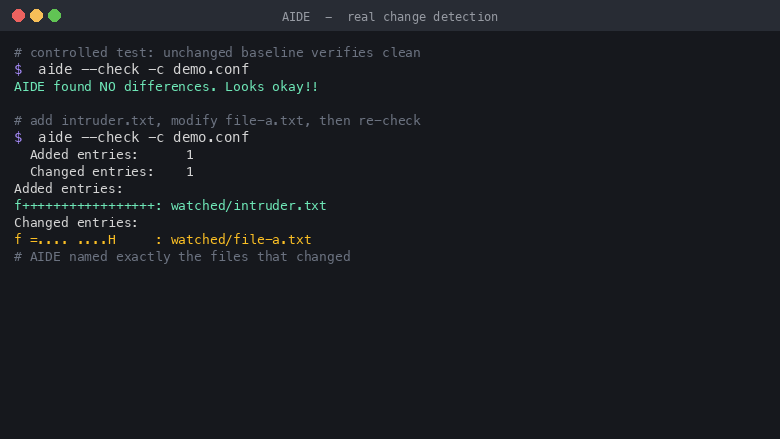
AIDE (Advanced Intrusion Detection Environment) is an open source host based file and directory integrity checker. It builds a cryptographic baseline of the attributes of the files it watches, permissions, ownership, size, timestamps and content hashes, and on every run reports exactly what has been added, removed or changed against that baseline. It is a host intrusion detection staple and a direct answer to compliance controls that mandate file integrity monitoring, such as PCI DSS requirement 11.5 and the CIS Benchmarks. There is no daemon, no network port and no credential: it is a purely local command line tool driven over SSH.
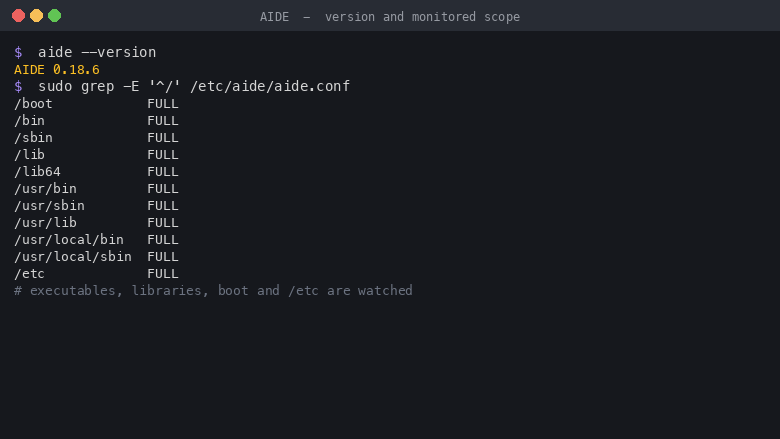
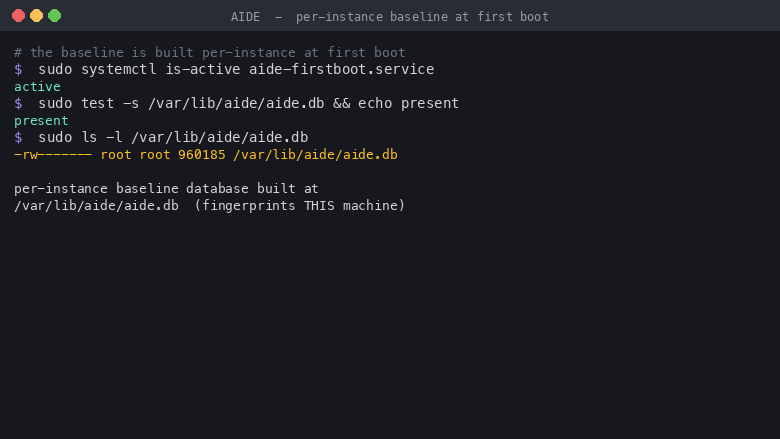
The cloudimg image builds the baseline per instance at first boot, so it fingerprints your own machine rather than the build server and the very first check is meaningful instead of drowning in spurious differences. It ships a focused, hardened monitored scope covering executables, libraries, boot and configuration, a systemd timer that runs a daily check and writes the report to a log ready for your pipeline, and a fail closed design that refuses to run a check without a valid baseline. AIDE installs from the operating system archive so it stays covered by standard security updates, and the image is paired with a step by step deploy guide and 24/7 support.
Real screenshots taken while testing this image against its deployment guide.
This is a repackaged open source software product wherein additional charges apply for cloudimg support services.
## AIDE File Integrity Monitor - Ready-to-Run AMI by cloudimg
AIDE (Advanced Intrusion Detection Environment) is the open-source, GPL-2.0 licensed host-based file and directory integrity checker. This AMI delivers AIDE fully configured as a ready-to-run integrity-monitoring appliance - SSH in and the baseline and scheduled check are already in place.
AIDE builds a cryptographic baseline database of file attributes - permissions, ownership, inode, size, timestamps and content hashes - and on every subsequent run reports exactly what has been added, removed or changed. It is a host intrusion detection staple and a direct answer to compliance controls that mandate file-integrity monitoring, such as PCI-DSS requirement 11.5 and the CIS Benchmarks.
## Why Choose This AMI Over Self-Installation
Standing AIDE up correctly is more subtle than installing a package: the baseline must be built on the real machine, the monitored scope must be tuned so the daily check is meaningful without drowning in noise, and the schedule and reporting must be wired up. This AMI handles all of it:
## How File-Integrity Monitoring Works Here
## Getting Started
1. Launch the AMI on your preferred EC2 instance type
2. Connect over SSH using your key pair
3. Confirm the per-instance baseline built at first boot with sudo aide --check --config=/etc/aide/aide.conf
4. Review the daily report at /var/log/aide/aide.log
5. After any intentional change, refresh the baseline with sudo aideinit
## Use Cases
## Security Practices
AIDE is installed unmodified from the operating system's official package archive, so it is covered by standard unattended security updates. The baseline database is generated per instance and stored read-restricted; for real tamper assurance, move a copy of the baseline off the instance or to read-only media. SSH access uses key-based authentication. AIDE opens no network socket and runs no daemon.
## About cloudimg
cloudimg provides pre-configured, production-ready AMIs with expert 24/7 support. Critical issues receive a one-hour average response. Support covers baseline initialization, tuning the monitored scope, interpreting integrity reports, wiring reports into your log pipeline, and moving the baseline off-box for stronger tamper assurance.
All product and company names are trademarks or registered trademarks of their respective holders. Use of them does not imply any affiliation with or endorsement by them.

The cloudimg image ships the free and open source, AGPL-3.0 licensed AliasVault, run the officially supported way as the...

This image runs Apache Directory Server (ApacheDS) 2.0, the Apache Software Foundation's extensible, embeddable director...

This image runs Apache SpamAssassin, the open source, Apache-2.0 licensed anti-spam platform.

Authentik is an open source identity provider: single sign-on, multi-factor authentication, user management and access c...

This image runs Authgear, the open source authentication server and identity provider.
This image runs Beelzebub, the open source low code honeypot and deception framework.