Base
Hardened build
minimal ports, security patches applied at build time

Serve offline Wikipedia and other ZIM content archives through a browsable web reader, secured and supported by cloudimg.
kiwix-serve is a self contained HTTP server that publishes offline content archives in the open ZIM format through a built in library and reader. A single archive can hold an entire offline copy of Wikipedia, a wiki, a documentation set or any web content, browsable and full text searchable from a web browser with no internet connection. It suits classrooms, field sites, clinics, ships, remote offices and air gapped networks that need a local knowledge base.
The cloudimg image runs kiwix-serve under systemd behind an nginx reverse proxy that enforces HTTP Basic Authentication, with the password generated on first boot so no credential is baked into the image. It ships a sample Wikipedia archive so the library has content immediately, a fully patched operating system with unattended security updates, a paired deployment guide and 24/7 cloudimg support.
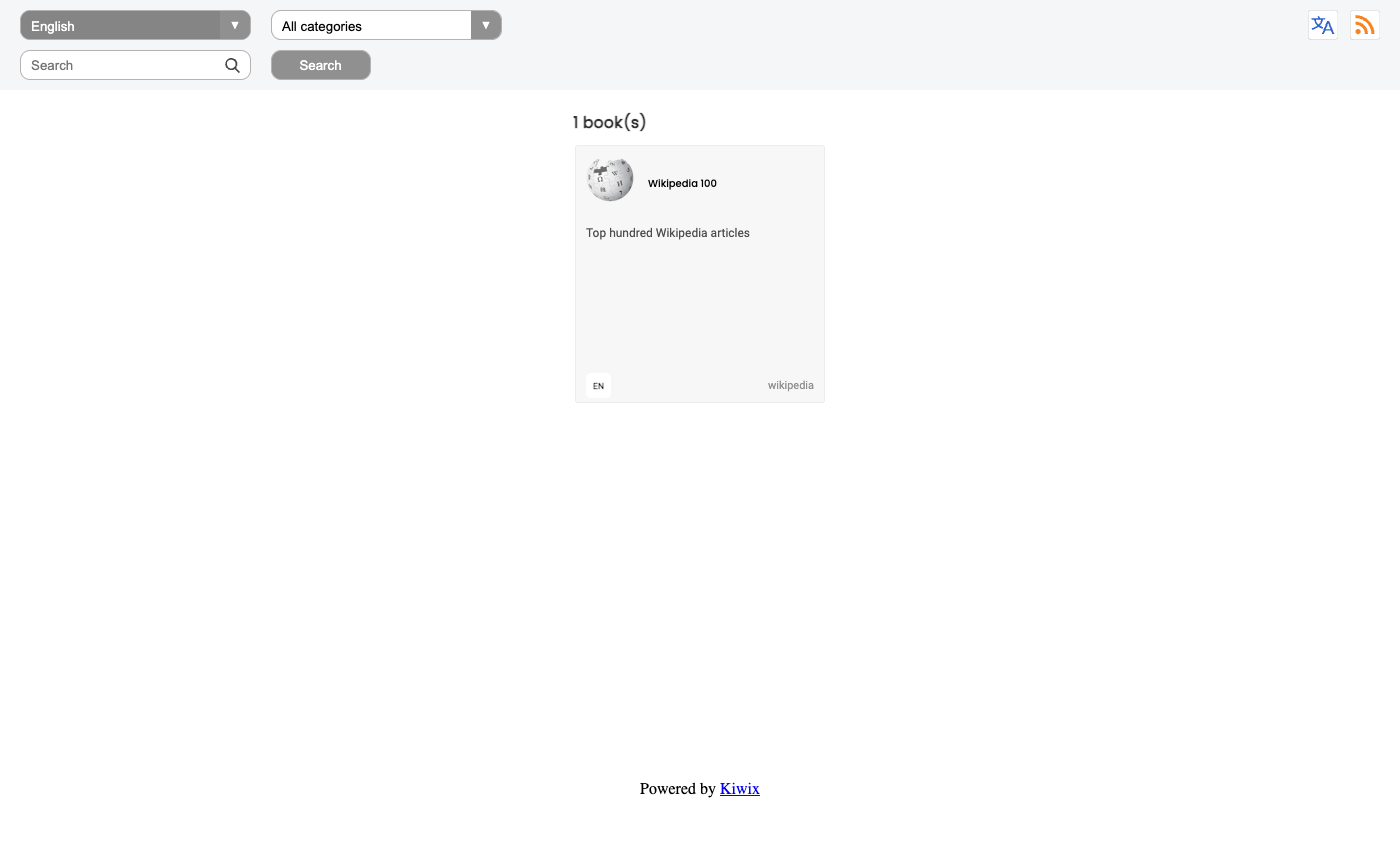
Real screenshots taken while testing this image against its deployment guide.



This is a repackaged open source software product wherein additional charges apply for cloudimg support services.
kiwix-serve is a lightweight, self-contained HTTP server that publishes offline content archives, packaged in the open ZIM format, through a built-in library and reader web interface. A single ZIM file can hold an entire offline copy of Wikipedia, Stack Exchange, Project Gutenberg, a wiki, a documentation set or any other web content, and kiwix-serve makes that content browsable and full-text searchable from a standard web browser with no internet connection required. This image delivers kiwix-serve 3.8.2 fully installed and running under systemd, so a working content library is available within minutes of launch, with no compilation and no configuration needed to get started.
The Kiwix project is used by schools, universities, NGOs, clinics, ships and field operators around the world to provide access to knowledge in low connectivity and air-gapped environments. This image packages that technology into a secure, production-ready deployment on AWS, backed by 24/7 cloudimg support.
What you get on first boot:
Sample content included: the image ships with the 100 most-read English Wikipedia articles so the library has real, browsable content immediately. The article text and media are Wikipedia content under the Creative Commons Attribution-ShareAlike licence and remain freely redistributable, with the publisher and licence shown on every book card and article.
Add your own archives: drop ZIM files into the content directory and the library refreshes automatically. Ready-made archives cover Wikipedia in many languages, Wiktionary, WikiHow, medical libraries, educational resources and more.
Secure by default: kiwix-serve binds to the loopback interface only and is never exposed directly. An nginx reverse proxy on port 80 enforces HTTP Basic Authentication, with a unique password generated on this instance's first boot and stored in a root-only file, never baked into the image. An unauthenticated request is refused, while a lightweight unauthenticated health-check endpoint is available for load balancers and monitoring. The operating system ships fully patched with unattended security updates enabled.
Common use cases include offline knowledge bases for classrooms, field sites, ships, clinics and remote offices, internal reference and documentation libraries for air-gapped and low connectivity networks, and hosting archived web content without any dependency on the live internet. To make the library public, remove the authentication directive from the nginx site and reload it, then open the matching port in your security group, as described in the deployment guide. The current release available is kiwix-serve 3.8.2.
This is a repackaged open source software product with additional charges for cloudimg support services. kiwix-serve is distributed under the GNU General Public License version 3. cloudimg is not affiliated with or endorsed by the Kiwix or openZIM project. All product and company names are trademarks or registered trademarks of their respective holders. Use of them does not imply any affiliation with or endorsement by them.

Apache Ozone is the scalable, distributed object store for Hadoop and cloud-native workloads. It exposes both an S3-comp...

This image runs ArozOS, a self hosted web desktop operating system and cloud file platform.

Backrest is a popular open source web interface and orchestrator for restic, the fast, secure, deduplicating backup prog...

This image runs Barman (Backup and Recovery Manager), the open source disaster-recovery manager for PostgreSQL from Ente...

This image runs Cloud Commander 19.19.1, the open source web based orthodox (two panel) file manager with a built in Edw...

The image installs Bacula 13.0.4 and runs the Director, a Storage Daemon writing to a file based volume, a local File Da...