Base
Hardened build
minimal ports, security patches applied at build time
Turn your runbooks into auditable, self service automation. uTask is OVH's open source automation engine: you declare a workflow as a YAML template with typed inputs, dependent steps, conditions and loops, and uTask runs it as a resumable task with full history, a REST API and a web dashboard. This image ships uTask with PostgreSQL behind an authenticating reverse proxy, with per instance credentials and an encryption key generated on first boot. Backed by 24/7 cloudimg expert support.
This image arrives installed, configured and hardened, so there is no manual setup before you can use it. It is built on a patched base, runs with credentials generated uniquely for your instance on first boot, and passes an automated health check before every release. Every deployment is backed by 24/7 support from cloudimg engineers.
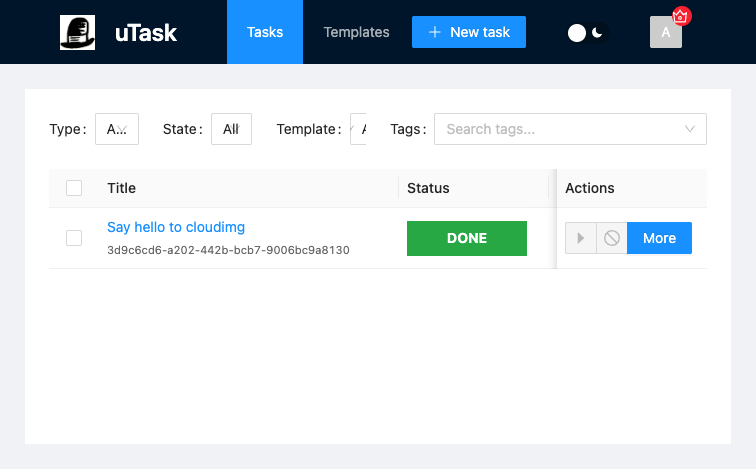
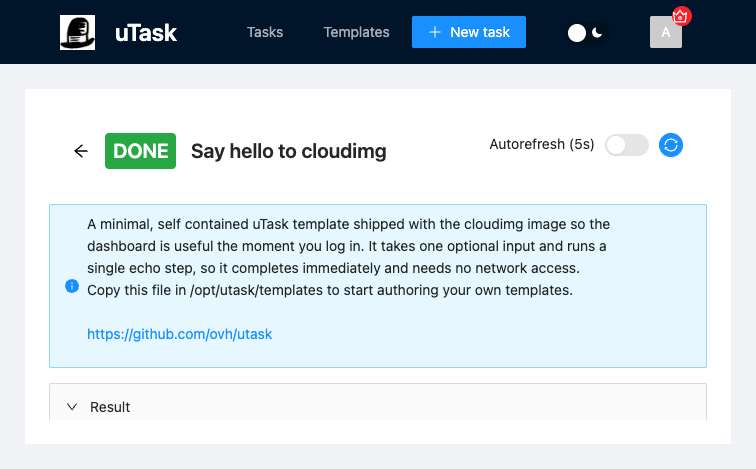
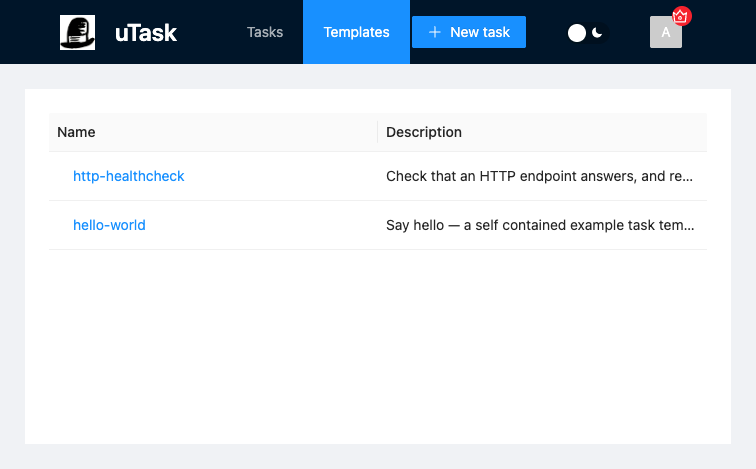
Real screenshots taken while testing this image against its deployment guide.
This is a repackaged open source software product wherein additional charges apply for cloudimg support services.
uTask is an open source automation engine from OVH for turning operational runbooks into auditable, repeatable, self service tasks. You describe a process once as a YAML task template, with typed and validated inputs, steps that declare their dependencies, conditions, loops and JSON schema checks on each step's output, and uTask takes care of the rest: it runs the task, records every step, retries what can be retried, pauses for human approval where you ask it to, and keeps a complete history you can inspect afterwards. Because a task is resumable, an interrupted run picks up where it stopped rather than starting again from the beginning.
This image delivers uTask 1.34.0 fully installed and configured, with its PostgreSQL database on the same machine, running as hardened systemd services behind nginx, so a working automation engine is answering within minutes of launch and you skip the database setup, schema loading, encryption key management and access control wiring. Two self contained example templates are already loaded, so the dashboard is useful the moment you log in and you have a working pattern to copy when you write your first template.
Authentication follows the design uTask itself prescribes. uTask has no built in login: it is meant to sit behind a trusted reverse proxy that tells it who the caller is. In this image nginx is that proxy. It authenticates every request against a credential unique to your instance and passes the verified username on to uTask, overwriting anything a client tries to claim for itself, and uTask is bound away from the network so the proxy cannot be sidestepped. Nothing secret is baked into the image: the database password, the dashboard password and the storage encryption key that protects every task input and result at rest are all generated on the first boot of each instance and written to a root only file, and the image ships with no database at all, so no build time data or shared key can follow you into production.
Key capabilities: declare workflows as versioned YAML templates instead of shell scripts on someone's laptop; expose them to your team as self service tasks through a web dashboard or a REST API; drive real systems with builtin actions for HTTP calls, SSH commands, scripts, email, notifications and subtasks; require human validation on the steps that need a second pair of eyes; and keep a full, encrypted, queryable audit trail of everything that ran, who asked for it and what it returned.
Get started: read the generated credentials, open the dashboard, run the bundled example task and watch the engine resolve it step by step, then drop your own template into the templates directory. cloudimg engineers can help you model your runbooks as templates, front the dashboard with your own TLS certificate and domain, wire uTask into your existing identity provider and monitoring, and plan encryption key rotation after purchase.
This is a repackaged open source software product with additional charges for cloudimg support services. uTask is licensed under the BSD 3 Clause License. All product and company names are trademarks or registered trademarks of their respective holders. Use of them does not imply any affiliation with or endorsement by them.

Accent is an open source, developer-oriented translation and localization management platform.
This image runs Apache Archiva, the open source build-artifact repository manager - a central, governed store for the bi...

Launch a production-ready Apache DolphinScheduler workflow scheduler in minutes with zero setup. All-in-one standalone d...

Apache JMeter is the de-facto open-source tool for load and performance testing of web applications, APIs, databases and...

This image runs Apache Subversion (SVN) 1.14, the Apache Software Foundation's enterprise centralised version-control sy...

This image runs Appsmith Community Edition, the open source low-code platform for building internal tools, admin panels,...