Base
Hardened build
minimal ports, security patches applied at build time

WebHook Tester, a self hosted endpoint that captures inbound webhooks so you can inspect exactly what a service sent.
WebHook Tester is an open source, self hosted endpoint for capturing, inspecting and debugging inbound HTTP requests. You create a session, which gives you a unique capture URL, and point any service that sends webhooks at it: a payment provider, a Git host, a CI system, a monitoring tool or your own application. Every request that arrives is recorded in full, and a web interface shows the exact HTTP method, every header, the query string, the client address and the complete request body, with a live feed that updates as requests arrive. You can inspect any captured request in detail, delete individual requests or clear a session, and configure the status code, headers, delay and body your endpoint returns so you can reproduce the behaviour a calling service expects.
It suits anyone integrating with a third party that sends webhooks: debugging a delivery against a real payload instead of guessing from documentation, capturing what a service actually sends before writing the handler, or reproducing a failing delivery.
Because a capture endpoint necessarily accepts unauthenticated requests, cloudimg ships it with the access split done properly. Capture URLs stay anonymous, which is what makes the tool useful, while the web interface and the management API sit behind a password generated uniquely on each instance's first boot, so nothing usable is baked into the image and the interface is never left open. New capture endpoints can only be created through the authenticated interface. Captured requests persist on disk across reboots with a sensible retention window, no separate database or cache is installed, the service runs as a non root user bound to loopback behind nginx, and every deployment comes with a paired deployment guide and 24/7 cloudimg support.
Real screenshots taken while testing this image against its deployment guide.
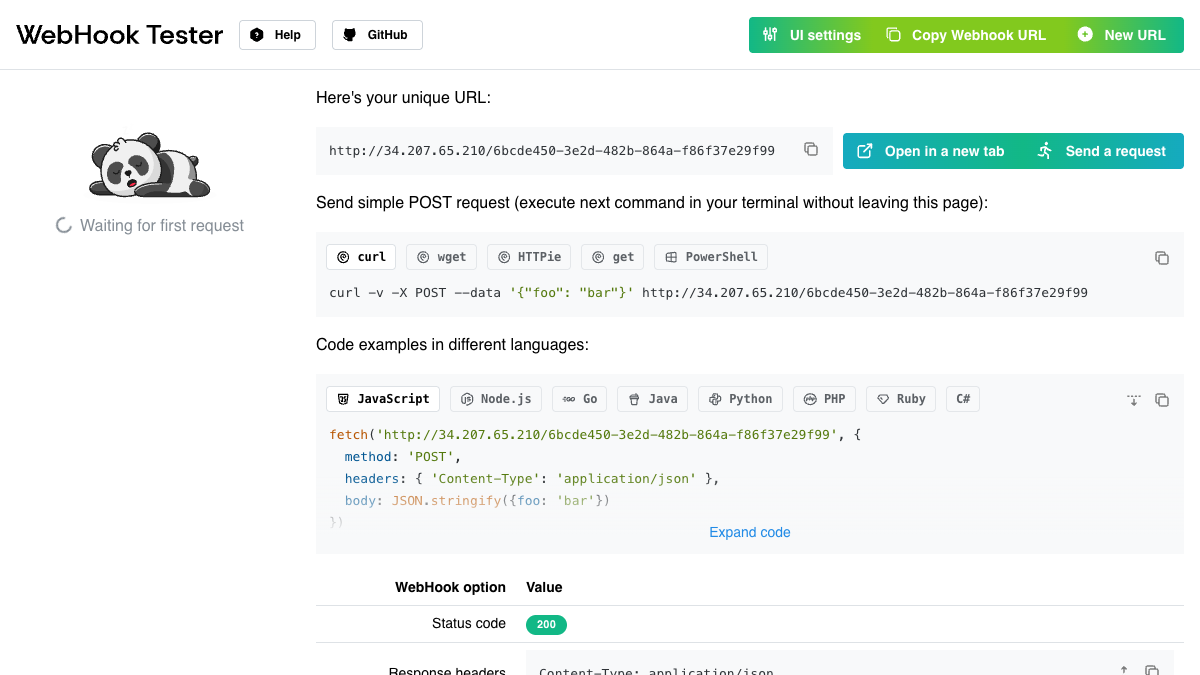
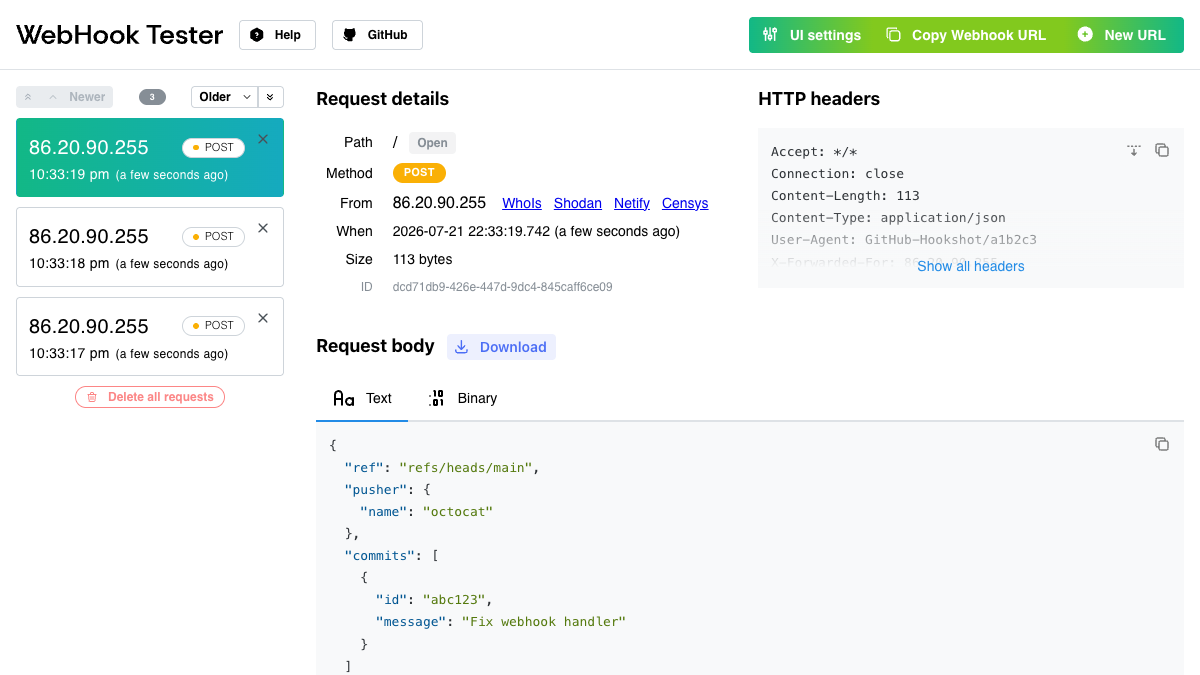
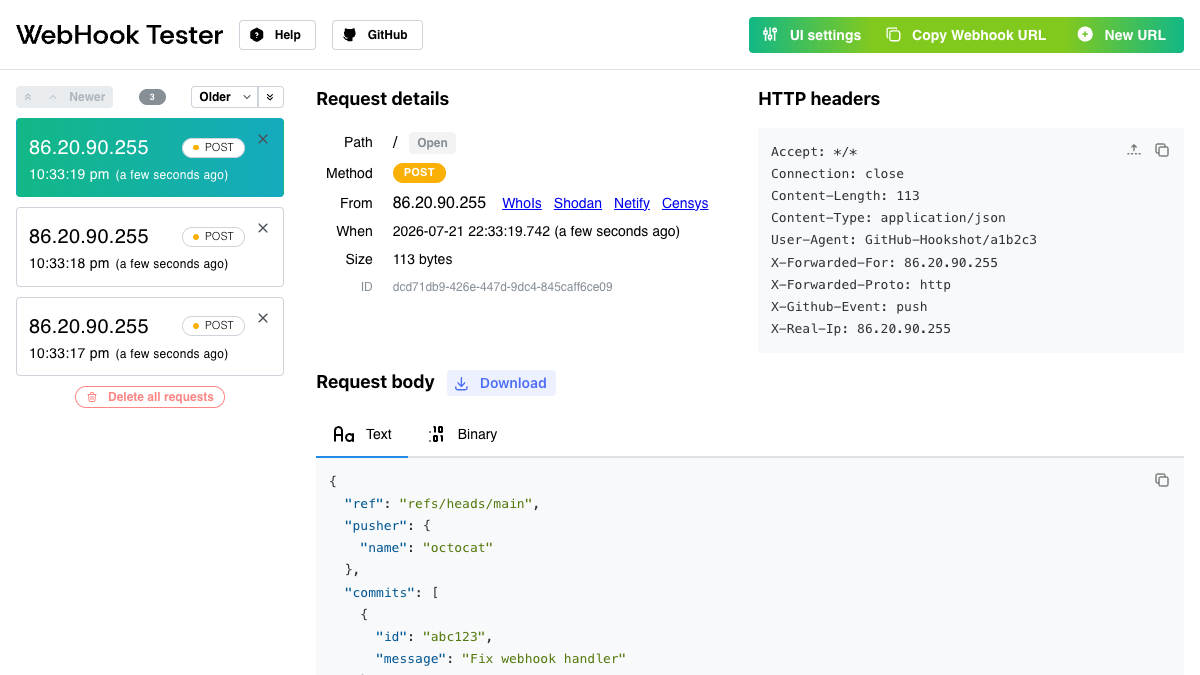
This is a repackaged open source software product wherein additional charges apply for cloudimg support services.
WebHook Tester is a self hosted endpoint for capturing, inspecting and debugging inbound HTTP requests. You create a session, which gives you a unique capture URL, and point any service that sends webhooks at it: a payment provider, a Git host, a CI system, a monitoring tool or your own application. Every request that arrives is recorded in full, and the web interface shows you exactly what was sent, including the HTTP method, every header, the query string, the client address and the complete request body, with a live feed that updates as requests arrive. You can inspect any captured request in detail, delete individual requests or clear a session, and configure what status code, headers, delay and body your endpoint returns so you can reproduce the behaviour the calling service expects.
This image delivers it fully installed and running under systemd behind an nginx front door, so a working capture endpoint is listening within minutes of launch with nothing to compile and no configuration required. Captured requests are stored on disk rather than only in memory, so they survive a reboot, and are kept for seven days with a limit of 128 requests per session and a 1 MiB request body cap. No separate database or cache is required or installed.
Access is deliberately split, because this product exists to receive requests from services that cannot authenticate. Your capture URLs are anonymous by design: any third party can POST to one and have the request recorded, which is exactly what makes the tool useful. Everything else is closed. The web interface and the management API sit behind HTTP Basic authentication using a password generated uniquely on this instance's first boot and never baked into the image, so an unauthenticated request to the interface or the API is rejected. New capture endpoints can only be created through the authenticated interface, so nobody else can mint endpoints on your instance. The application runs as a non root user, hardened with systemd sandboxing and bound to loopback rather than exposed directly, and the operating system ships fully patched with unattended security updates enabled.
Use it to debug a webhook integration against a real payload instead of guessing from documentation, to capture what a third party service actually sends before you write the handler, to reproduce a failing delivery, or to give your team a private inspection endpoint that keeps request data inside your own cloud account rather than sending it to a public inspection service. The paired deployment guide walks through creating a session, sending a real webhook to it from outside the instance, inspecting the headers and body, and managing retention.
cloudimg is not affiliated with or endorsed by the WebHook Tester project. WebHook Tester is distributed under the MIT license. All product and company names are trademarks or registered trademarks of their respective holders. Use of them does not imply any affiliation with or endorsement by them.
This image runs Apache Archiva, the open source build-artifact repository manager - a central, governed store for the bi...

Apache JMeter is the de-facto open-source tool for load and performance testing of web applications, APIs, databases and...
Apache TomEE is the Jakarta EE application server from the Apache Tomcat project.

This image runs Appsmith Community Edition, the open source low-code platform for building internal tools, admin panels,...

This image runs Atlantis 0.46 (Apache-2.0), the open source server that automates Terraform and OpenTofu pull request wo...

Pre-configured self-hosted Atuin sync server: an end-to-end-encrypted, searchable shell-history sync backend for the Atu...