Base
Hardened build
minimal ports, security patches applied at build time
Beelzebub, a low code honeypot and deception framework that stands up decoy services to lure, log and alert on attacker activity across your network.
Beelzebub is a self hosted honeypot and deception framework. It stands up low interaction decoy services that impersonate real infrastructure, a fake SSH shell, a fake web server, a fake database, so that any connection to them is suspicious by definition. Each decoy is defined in simple YAML, and every interaction is captured as a structured event and exposed as Prometheus metrics, giving you an early warning tripwire for reconnaissance and intrusion attempts. Because nothing legitimate should ever touch a decoy, a single hit is a high signal, low noise alert, unlike scanning production logs for anomalies. The decoys run inside Beelzebub's own sandbox, so they present an inviting target while granting no real access to the host, and you can extend or replace them with your own service definitions.
It suits security teams who want an internal tripwire that fires the moment something touches a service it should not, researchers studying attacker behaviour, and defenders who want to slow and misdirect an intruder who has already gained a foothold.
A honeypot is only useful if its own management plane is not itself a liability, and cloudimg ships it that way. The decoy services are deliberately left inviting because that is their whole purpose, but the real observability surface is secured: the Prometheus metrics endpoint is bound to loopback and fronted by an nginx reverse proxy that requires a password, with a public health endpoint for load balancer probes. There are no shared or default credentials, a unique metrics password is generated on each instance's first boot and written to a root only note, and the decoy SSH runs on a separate port so it never clashes with your real administrative access. The single binary is compiled from the pinned release and the build toolchain is stripped before capture, the image is scanned clean of fixable vulnerabilities, and every deployment comes with a paired deploy guide and 24/7 cloudimg support.
Real screenshots taken while testing this image against its deployment guide.
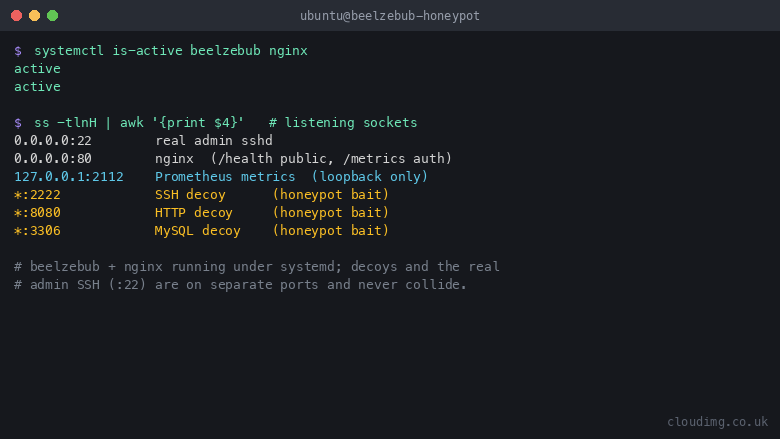
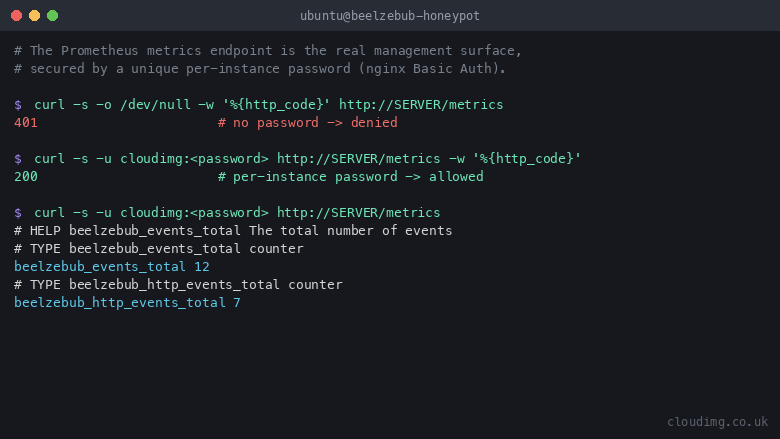
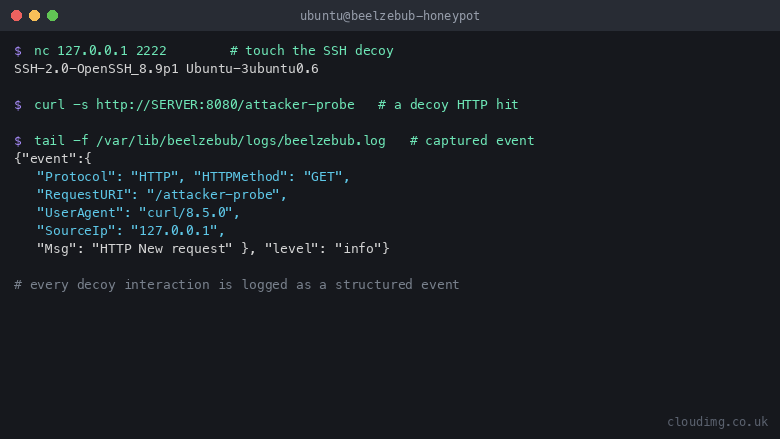
This is a repackaged open source software product wherein additional charges apply for cloudimg support services.
## Overview
Beelzebub is an open source, low-code honeypot and deception framework. It stands up low-interaction decoy services that look like real infrastructure - a fake SSH shell, a fake web server, a fake database - so that any connection to them is, by definition, suspicious. Every interaction is captured as a structured event and exposed as Prometheus metrics, giving you an early-warning tripwire for reconnaissance and intrusion attempts inside your network, all defined in simple YAML. This image delivers it fully installed and running under systemd, so a working deception layer is listening within minutes of launch.
Unlike multi-container honeypot stacks that require orchestration expertise, or single-protocol tools that cover only SSH, this AMI gives you multiple decoy protocols from a single Go binary with no container runtime, no build toolchain, and no manual systemd or nginx configuration required.
## Deception and Attack Capture
Out of the box the image runs three decoy services - an SSH decoy, an HTTP decoy and a database decoy - each defined by an editable YAML file you can extend or replace with your own decoys. When something connects, Beelzebub records the interaction as a structured event and increments its Prometheus counters, so you can scrape the activity into your SIEM, dashboards and alerting. Because nothing legitimate should ever touch a honeypot, every event is worth investigating. The decoys use static, built-in responses, so no external API key is needed; the optional AI-backed shell is disabled by default and is enabled only if you choose to supply your own key.
## Two Separate Surfaces, Secure by Default
A honeypot's decoy services are meant to be inviting, and they run inside Beelzebub's own sandbox so they grant no real access to the host. This image keeps your real administrative SSH on its own standard port, entirely separate from the decoy SSH, so deploying the honeypot never interferes with how you manage the instance. The Prometheus metrics endpoint is bound to the loopback interface and served through an nginx reverse proxy that is ready for your TLS certificate. An unauthenticated health endpoint is available for load balancer probes, while the metrics endpoint requires a password. There are no shared or default credentials - a unique password is generated on each instance's first boot and written to a root-only file. The shipped security group opens only the administrative SSH port and the metrics port; the decoy ports are closed until you deliberately open them.
## Hardened, Minimal Image
The Go binary is compiled from the pinned upstream release during image build, and the compiler and source tree are removed before the image is captured, so what ships is a single static binary with no build toolchain left behind. The daemon runs as a dedicated non-root user under a hardened systemd unit, and the operating system ships fully patched with unattended security updates enabled.
## Ready to Use
Connect over SSH on the administrative port and the honeypot is already running. Read the welcome notes for your first-boot metrics password and the decoy port numbers, open the decoy ports to the networks you want to observe, scrape the metrics, and watch an interaction being logged. The paired deployment guide walks through retrieving the metrics password, scraping the metrics, watching a capture land in the event log, and adding your own decoy services.
Want a guided walkthrough before you commit? Contact cloudimg support to schedule a brief deployment consultation at no extra charge.
## Use Cases
## cloudimg Support
24/7 technical support by email and live chat.

The cloudimg image ships the free and open source, AGPL-3.0 licensed AliasVault, run the officially supported way as the...

This image runs Apache Directory Server (ApacheDS) 2.0, the Apache Software Foundation's extensible, embeddable director...

This image runs Apache SpamAssassin, the open source, Apache-2.0 licensed anti-spam platform.

Authentik is an open source identity provider: single sign-on, multi-factor authentication, user management and access c...

This image runs Authgear, the open source authentication server and identity provider.

BloodHound Community Edition uses graph theory to reveal the hidden and unintended privilege relationships in an Active ...