Base
Hardened build
minimal ports, security patches applied at build time

LibreSign, an open source digital document signing platform, shipped with its entire signing toolchain already installed and its certificate authority minted on your own instance.
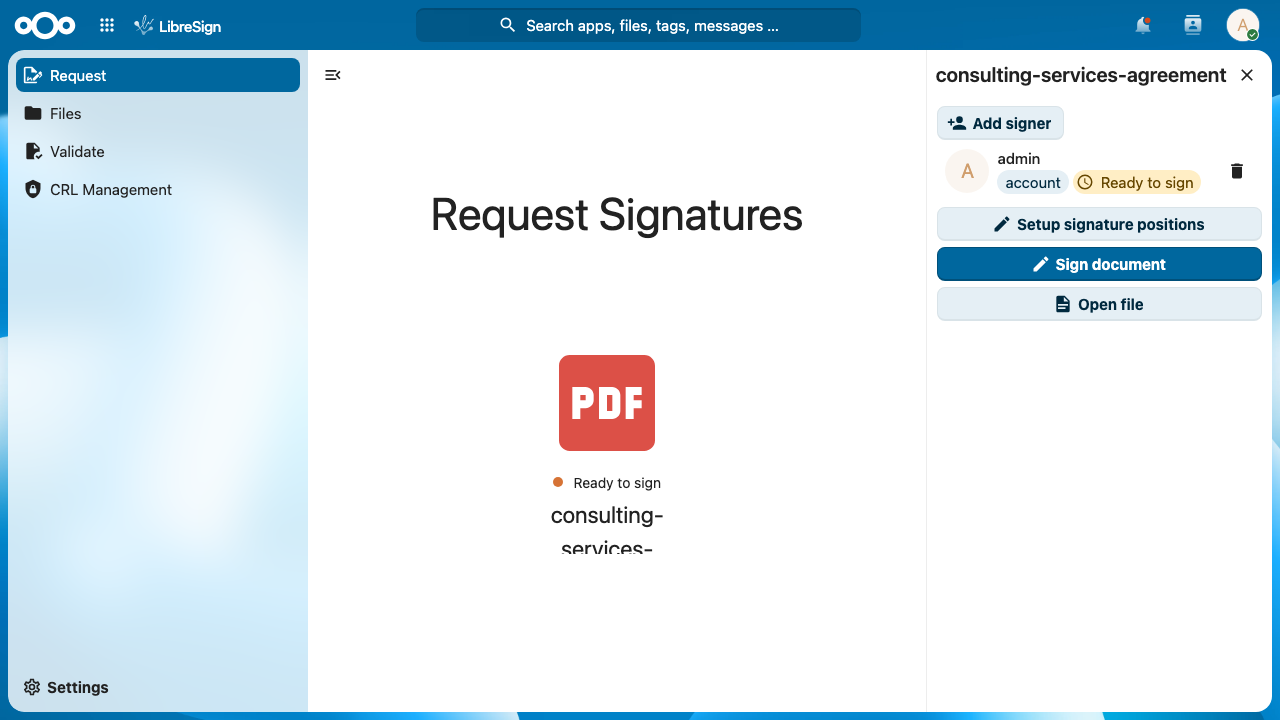
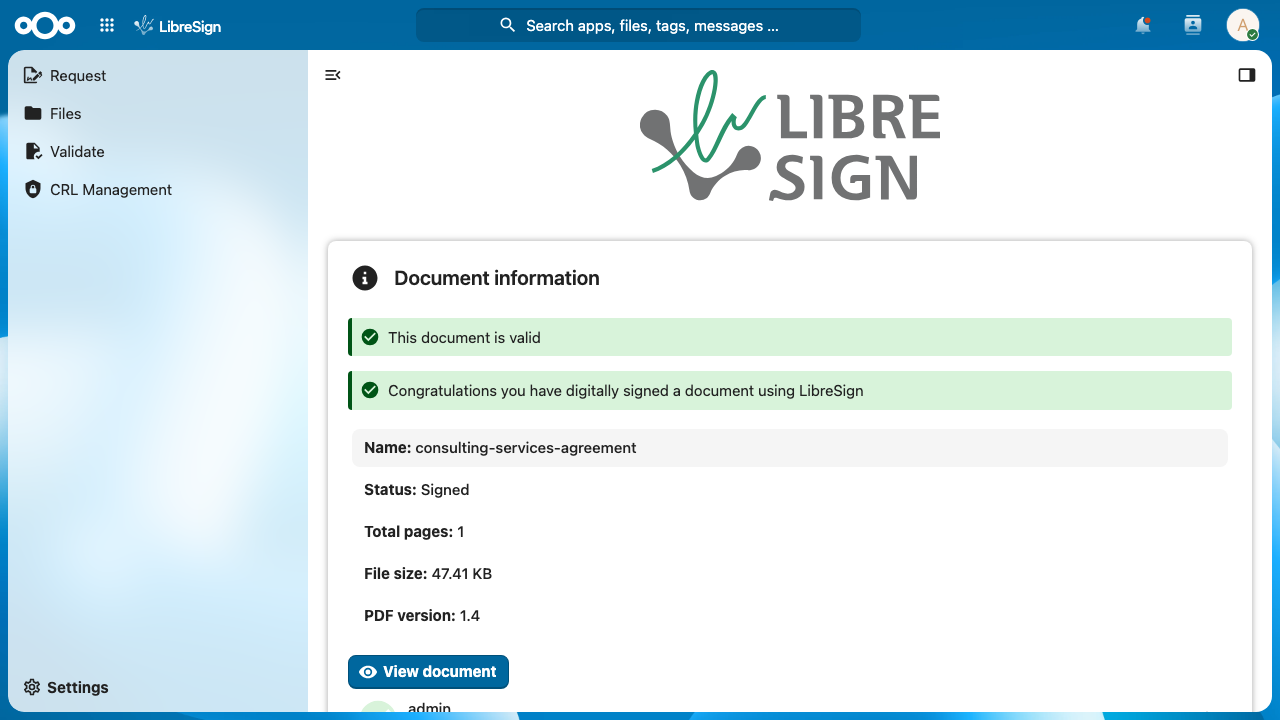
LibreSign gives an organisation a controlled document signing workflow. You upload a document, choose who signs it and in what order, track the request as each person responds, and end up with a signed PDF that carries a real cryptographic signature anyone can validate afterwards. Signers can be accounts on the instance or people invited by email, and every request keeps a traceable record of who was asked, when, and what they did.
LibreSign is built and distributed as an application for Nextcloud, so this is the whole stack rather than a single package: the Nextcloud server that stores the documents and holds the accounts, the LibreSign application itself, and the signing toolchain underneath it. The instance issues its own signing certificates from a certificate authority it generates for itself, so the private keys behind every signature stay on the machine you control rather than with a signing service.
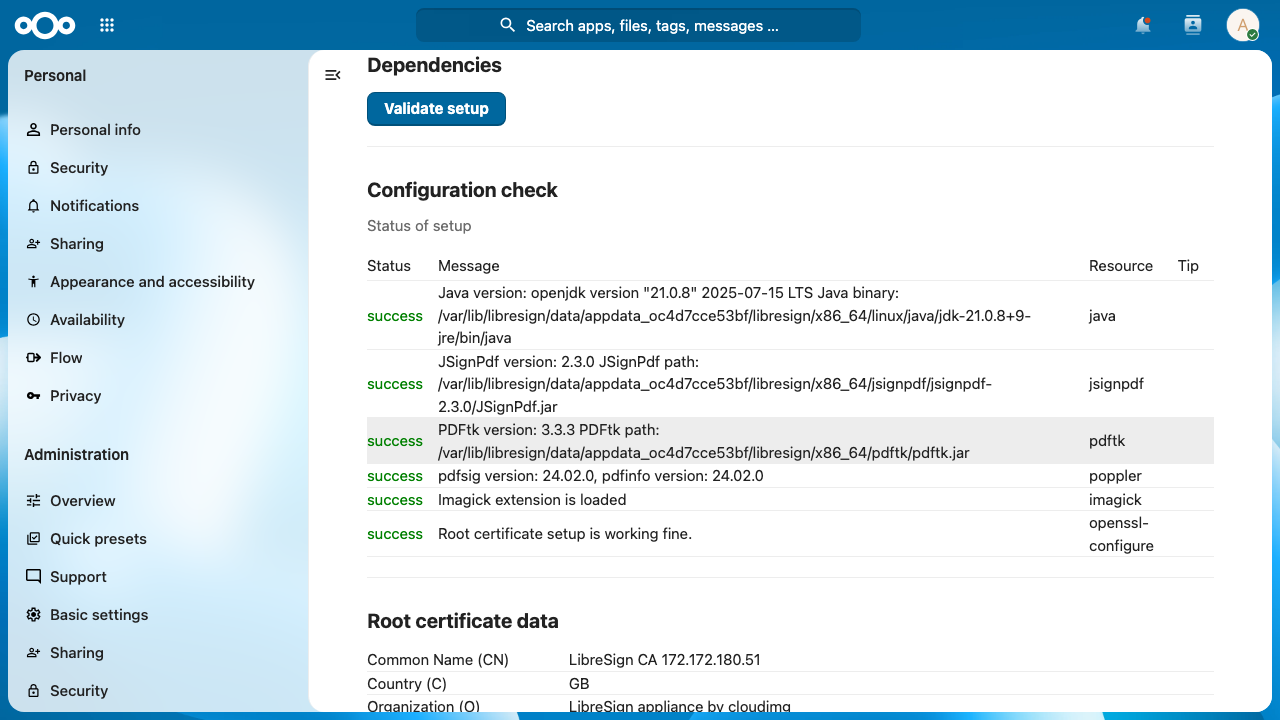
The part that normally goes wrong is the toolchain. LibreSign cannot sign anything until a Java runtime, JSignPdf and a PDF toolkit are present, and out of the box it downloads them from the internet the first time an administrator tries to use it, which fails outright on a locked down network and leaves a half configured signer if it is interrupted. cloudimg installs all of it at build time, checksum verified, and the instance passes the signer's own integrity checks with no outbound access at all, so it signs the moment it boots.
The second thing cloudimg closes is identity. Everything a signature depends on is generated on your own instance the first time it boots, before the web front door is allowed to start: the administrator password, the database and cache passwords, the instance identifier, the session secret and password salt, the TLS certificate, and the root certificate authority that issues every signer certificate. No two instances share a value and nothing usable is baked into the image, so the private key behind your signatures never existed anywhere else. Only three ports are reachable, the database and cache answer on the loopback interface only and the cache refuses unauthenticated connections, documents and database sit on a dedicated data volume you can back up as one mount point, and the base is fully patched with unattended security updates left enabled. Every image is paired with a deploy guide tested against this exact build and backed by 24/7 cloudimg support.
Real screenshots taken while testing this image against its deployment guide.

Actual Budget is a free, open source, local first personal finance application built around the proven envelope budgetin...

Admidio is the open source membership management platform for clubs, associations and non profit organisations.

AdventureLog is a self-hosted travel companion. It lets you log the countries and regions you have visited, plan future ...
Aim is an open-source ML experiment tracker: your training code logs metrics, hyperparameters and other artifacts as it ...

The cloudimg image ships the free and open source, GPL-3.0 licensed AirTrail application, run the officially supported w...
Akkoma is a lightweight, highly customisable open-source server for the fediverse: a self-hosted, federated microbloggin...