Base
Hardened build
minimal ports, security patches applied at build time

Declarative YAML workflow automation for SRE and DevOps teams. uTask turns runbooks into resumable, auditable tasks with encrypted history and a web dashboard.
This image arrives installed, configured and hardened, so there is no manual setup before you can use it. It is built on a patched base, runs with credentials generated uniquely for your instance on first boot, and passes an automated health check before every release. Every deployment is backed by 24/7 support from cloudimg engineers.
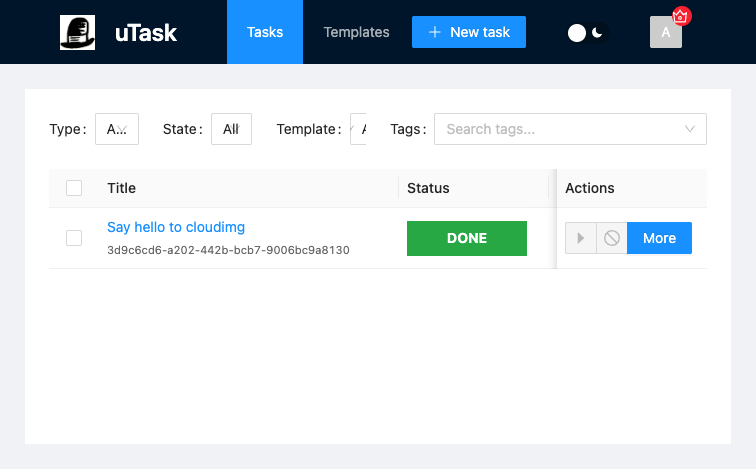
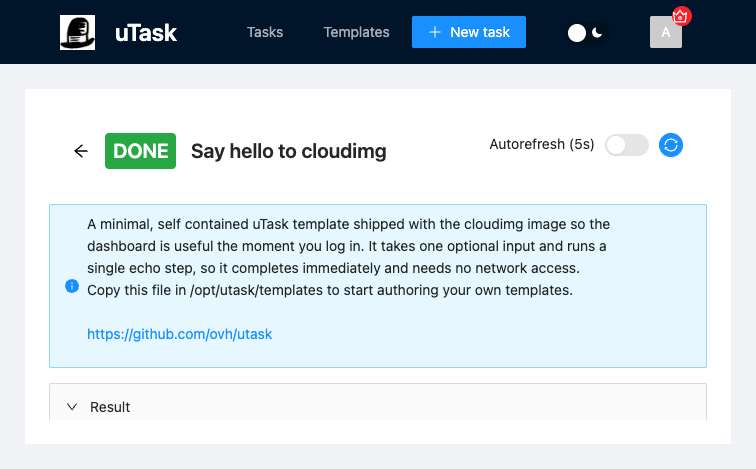
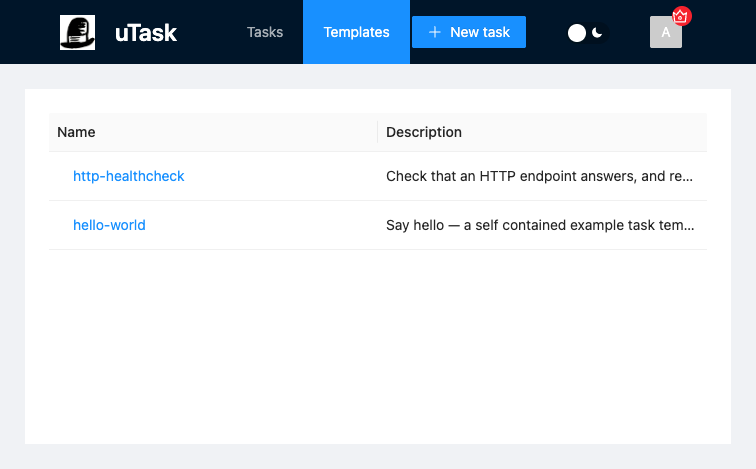
Real screenshots taken while testing this image against its deployment guide.
This is a repackaged open source software product wherein additional charges apply for cloudimg support services.
# Why uTask Over Other Automation Engines uTask is OVH's open source automation engine purpose-built for turning operational runbooks into auditable, repeatable, self-service tasks. Unlike imperative job runners where logic lives in scattered scripts, uTask uses a purely declarative YAML model: you describe a process once as a task template with typed and validated inputs, steps that declare their dependencies, conditions, loops, and JSON schema checks on each step's output. The engine handles execution, retries, human approval gates, and maintains a complete encrypted audit trail - all queryable via REST API or web dashboard. Because tasks are resumable by design, an interrupted run picks up exactly where it stopped rather than restarting from the beginning. This matters for long-running workflows spanning multiple systems where partial re-execution would cause inconsistencies or duplicate actions. ## Ready to Run in Under 10 Minutes This AMI delivers uTask fully installed and configured with its PostgreSQL database on the same machine, running as hardened systemd services behind nginx. A working automation engine is answering within minutes of launch - you skip the database setup, schema loading, encryption key management, and access control wiring that a manual install requires. Two self-contained example templates are preloaded so the dashboard is useful the moment you log in and you have a working pattern to copy when you write your first template. ## Concrete Workflow Scenario Consider automating a quarterly access review across your infrastructure: uTask can orchestrate SSH connections to each server to pull access lists, aggregate results, pause for manager approval on flagged accounts, execute revocations on approval, send notification emails, and record the entire chain as an encrypted audit record. Each step declares its dependencies, so failures are isolated and retried without re-running completed work. The same pattern applies to deployment rollbacks requiring SRE sign-off, scheduled compliance checks, or any multi-step process your team currently executes from a wiki page. ## Security Architecture Authentication follows the design uTask itself prescribes. uTask has no built-in login - it sits behind a trusted reverse proxy that identifies the caller. In this image, nginx is that proxy. It authenticates every request against a credential unique to your instance and passes the verified username to uTask, overwriting anything a client tries to claim. uTask is bound away from the network so the proxy cannot be sidestepped. Nothing secret is baked into the image: the database password, the dashboard password, and the storage encryption key that protects every task input and result at rest are all generated on the first boot of each instance and written to a root-only file. The image ships with no database, so no build-time data or shared key can follow you into production. ## Key Capabilities - Declare workflows as versioned YAML templates instead of shell scripts on someone's laptop

Accent is an open source, developer-oriented translation and localization management platform.

Altair GraphQL Client is an open-source, self-hosted GraphQL IDE for building, sending and inspecting GraphQL requests.
This image runs Apache Archiva, the open source build-artifact repository manager - a central, governed store for the bi...

This image runs Apache Camel Karavan, an open source visual integration designer and toolkit for Apache Camel.

Apache JMeter is the de-facto open-source tool for load and performance testing of web applications, APIs, databases and...

Launch a content crawler and search index in minutes. ManifoldCF, PostgreSQL and Apache Solr come preinstalled and wired...