Base
Hardened build
minimal ports, security patches applied at build time

self hosted machine translation, running entirely on infrastructure you control
LibreTranslate is a free and open source machine translation engine you run yourself. It exposes a simple REST API and a small web interface, and it translates on the machine itself using offline neural models, so the text you submit never reaches a third party service. It is a practical alternative to a hosted translation API wherever data residency, privacy, predictable cost or air gapped operation matters. It is automatic machine translation, not human or certified translation.
The cloudimg image arrives ready to translate: the offline neural models for nine languages are already on disk, so the service answers on first boot with no model download and no internet call. It ships closed rather than open, with API key enforcement on by default, and each instance generates its own key and its own TLS certificate at first boot, so nothing shared is baked in. The model store and the application runtime each sit on their own resizable volume, apart from the operating system disk. A paired deploy guide walks through the first authenticated call, adding languages and installing your own certificate, and 24/7 cloudimg support is included.
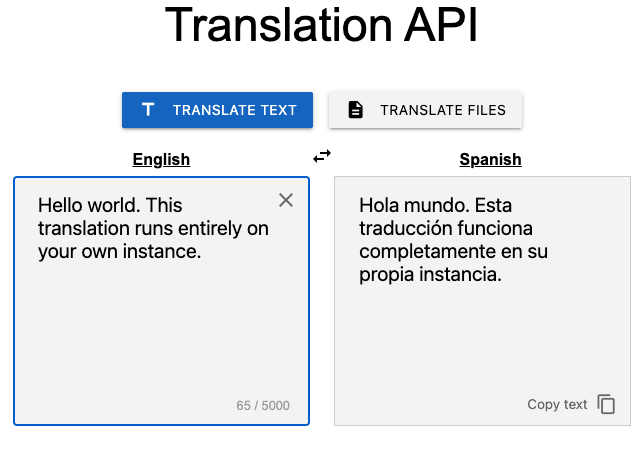
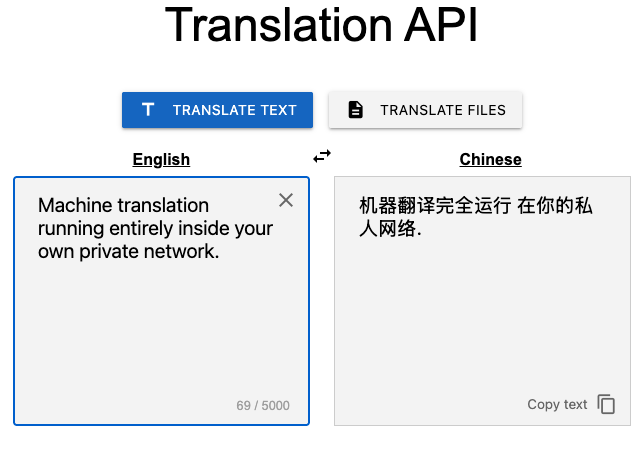
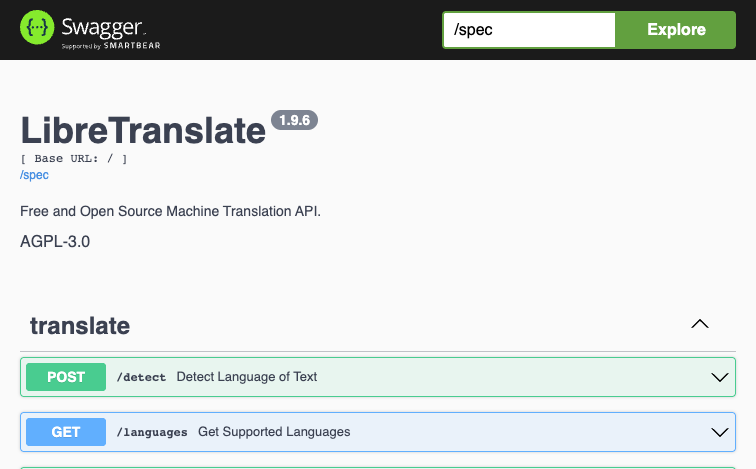
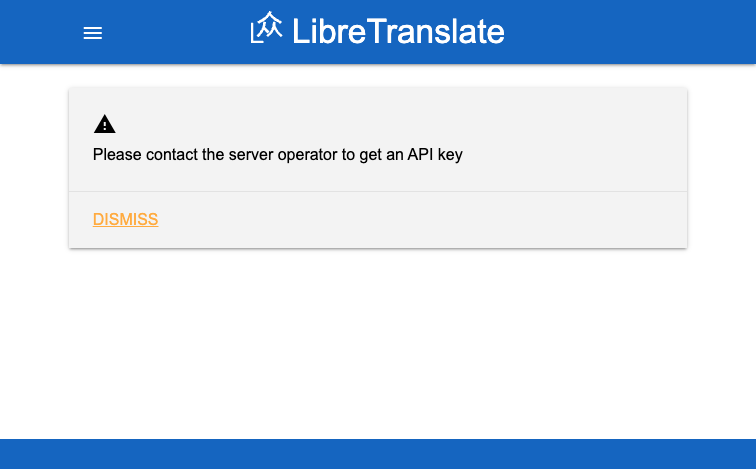
Real screenshots taken while testing this image against its deployment guide.
This is a repackaged open source software product wherein additional charges apply for cloudimg support services.
## LibreTranslate - Your Own Translation API, Working on First Boot
LibreTranslate is a free and open source machine translation engine you run yourself. It exposes a simple REST API and a small web interface, translating entirely on the instance so the text you submit never leaves infrastructure you control. This image delivers it fully installed behind nginx over HTTPS, with the neural models already on disk. A working translation service answers requests minutes after launch with no Python packaging, no model download, and no reverse proxy configuration.
## Nine Languages, Offline, With No GPU
The offline Argos Translate neural models for Arabic, Chinese, English, French, German, Italian, Portuguese, Russian and Spanish are baked into the image, covering all seventy two directional pairs across those nine languages. Translation works with the instance fully isolated from the internet. This is a deliberate subset, not the whole catalogue: the complete upstream model set is one hundred packages and several further gigabytes. The user guide shows how to add any further language, and the model volume is sized so the entire upstream set fits without touching the operating system disk. The engine runs on CPU only and does not provide GPU acceleration.
## Secured By Default, With No Shared Credential
An open translation endpoint on the public internet is a compute abuse risk, so this image ships with API key enforcement switched on. Every translation request needs a key, including requests made from the web interface, where you paste the key once. No usable key is baked into the image. On first boot the instance generates its own random API key and writes it to a file readable only by root, and it also generates its own self signed TLS certificate, so no two instances share a key or a private key. Requests are served over HTTPS on port 443 from the very first call, which matters because the API key travels in the request body. Port 80 answers a plain liveness check and redirects everything else to HTTPS. LibreTranslate itself binds only to the loopback interface, with nginx as the sole public listener, and request rate and character limits bound abuse.
## Separate, Resizable Storage Volumes
The neural model store and the application runtime each live on their own dedicated storage volume, independently resizable and separate from the operating system disk, so you can grow the model library without rebuilding the instance.
## What This Is, And What It Is Not
This is a machine translation engine. It produces automatic translations suitable for understanding content, powering search, pre translating a content pipeline or serving in product features where an automatic translation is appropriate. It is not human translation and it is not certified or sworn translation, and output should be reviewed by a competent speaker before it is relied upon in a legal, medical or safety context.
## Use Cases
## Get Started
Browse to the instance address over HTTPS, read your generated API key from the root only file on the instance, paste it into the web interface or pass it as the api_key field on a POST to /translate, and you have a working translation endpoint. The paired cloudimg deploy guide covers launch, the first authenticated call, adding languages, enabling additional API keys and replacing the self signed certificate.
## cloudimg Support
24/7 technical support by email and live chat. Our engineers help with deployment, API key management, adding and loading further language models, TLS certificates and custom domains, reverse proxy and rate limit tuning, and sizing for throughput.
## Licensing
LibreTranslate is licensed under the GNU AGPL-3.0 and the complete corresponding source of the installed version is shipped on the instance. The Argos Translate library is separately dual licensed MIT or CC0. The Argos model packages are distributed by the Argos Open Tech project and a manifest identifying every model package installed is written onto the instance. All product and company names are trademarks or registered trademarks of their respective holders. Use of them does not imply any affiliation with or endorsement by them.

JupyterLab is the interactive development environment behind most of the world's data science and research computing.

ContextForge MCP Gateway is IBM's open-source gateway, registry and proxy for the Model Context Protocol (MCP), the stan...

This image runs Crawl4AI, a fast, open source web crawler and scraper that converts web pages into clean, LLM-ready Mark...

This image runs Dify, a source-available platform for building and operating LLM applications.

Docling Serve is the HTTP API service around Docling, an open source toolkit that converts documents into clean, structu...
This image runs Evidently, the open source platform for evaluating, testing and monitoring machine learning, large langu...