Base
Hardened build
minimal ports, security patches applied at build time

distributed tracing, service metrics and logs in one self hosted observability platform
Apache SkyWalking is an open source application performance monitoring and observability platform. It collects distributed traces, service and instance metrics, and logs from instrumented applications and visualizes service topology, latency, throughput and error rates in a built in web interface, backed by a purpose built storage engine.
cloudimg ships SkyWalking as a ready to run single node appliance: the analysis backend, the web interface and an Apache-2.0 BanyanDB datastore start on boot, a unique interface password is generated on first boot, all telemetry lives on a dedicated independently resizable data volume, and every deployment comes with a paired step by step guide and 24/7 cloudimg support.
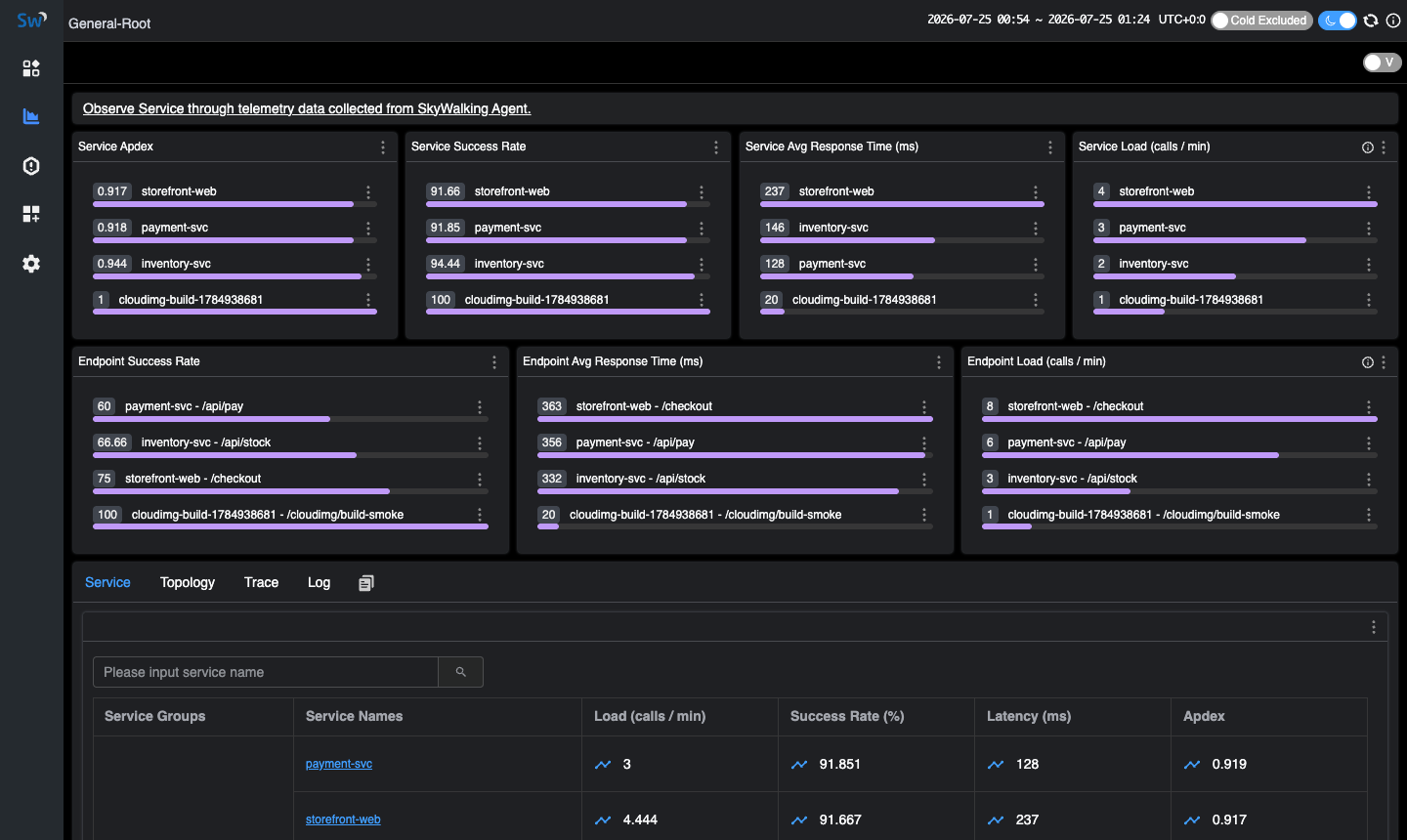
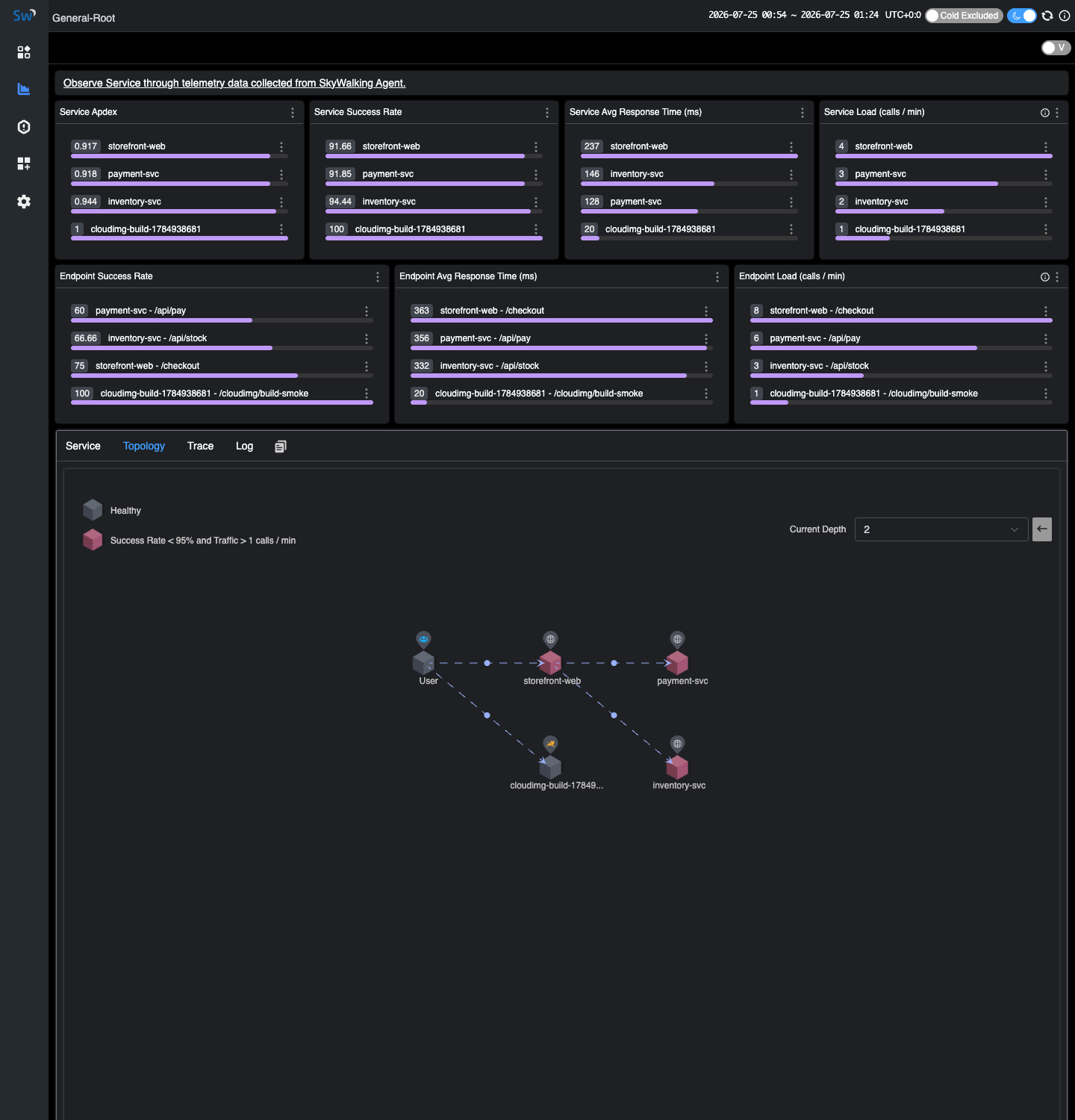
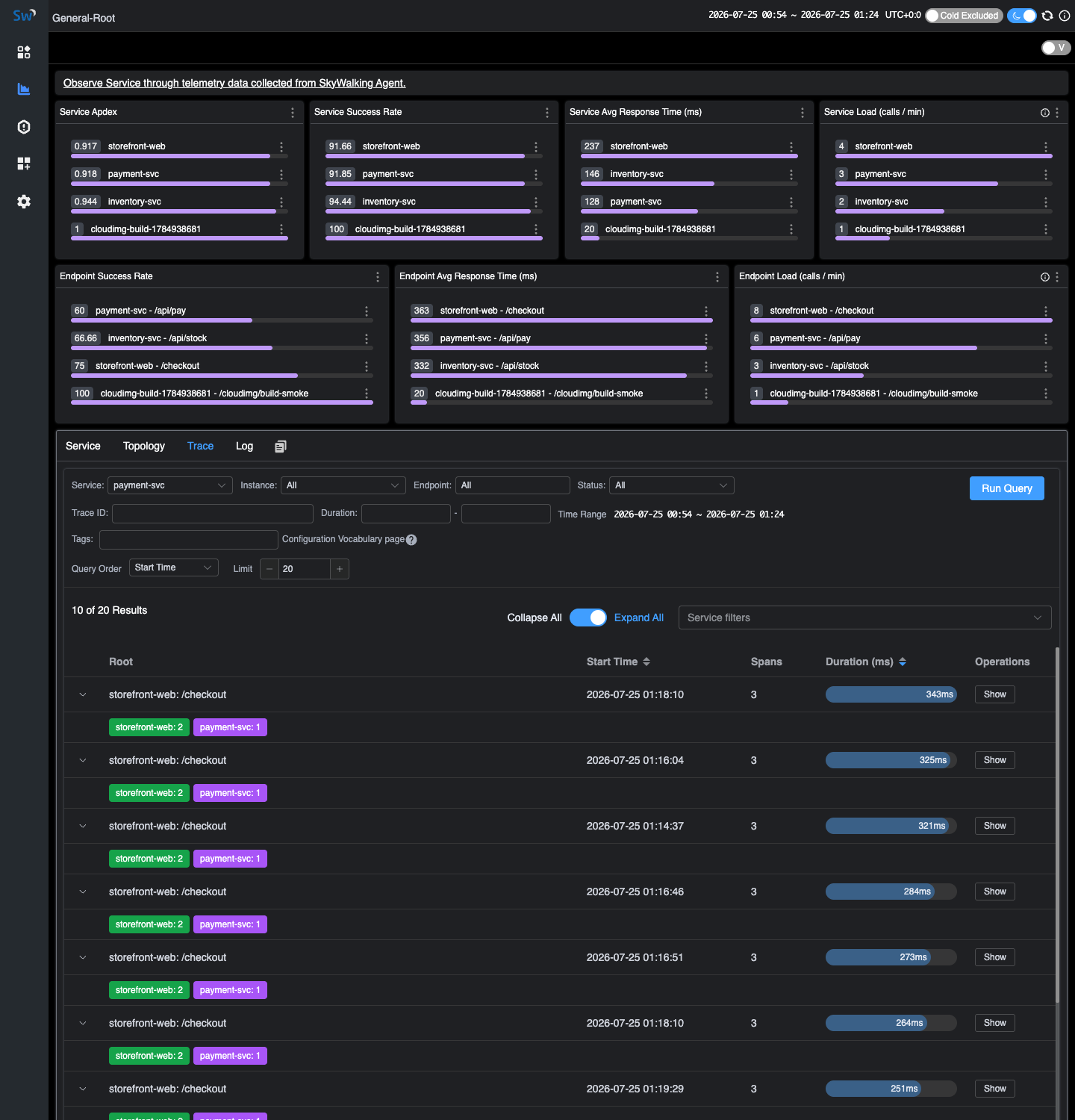
Real screenshots taken while testing this image against its deployment guide.
This is a repackaged open source software product wherein additional charges apply for cloudimg support services.
## Self-Hosted APM That Delivers Traces in Minutes, Not Days
Apache SkyWalking is an open-source Application Performance Monitoring (APM) and observability platform that collects distributed traces, service and instance metrics, and logs from your applications. It visualizes service topology, latency, throughput, and error rates in a built-in web UI. This image delivers SkyWalking as a single-node appliance - the OAP (Observability Analysis Platform) backend, the web UI, and an embedded Apache BanyanDB datastore - so you can point your first agent at it and see traces within minutes of launch rather than spending days assembling the stack by hand. The current release is Apache SkyWalking 10.4.0.
## Who This Is For
## What You Get on First Boot
## Why Apache BanyanDB Instead of Elasticsearch
SkyWalking needs a storage engine. This image ships Apache BanyanDB, licensed entirely under Apache-2.0 - the observability database the SkyWalking project builds and maintains for exactly this purpose. Unlike source-available search engines (e.g., those under SSPL), BanyanDB requires no license compliance review, no cluster sizing for a separate search infrastructure, and no additional operational overhead. Every byte of this appliance is open source and redistributable.
## Architecture Overview
The stack runs as cooperating services on a single instance. nginx receives inbound HTTP on port 80 and reverse-proxies to the SkyWalking UI on the loopback interface, enforcing HTTP basic authentication. The UI reads observability data from the OAP server, which stores and queries traces, metrics, and logs in a co-located BanyanDB node also bound to loopback. All telemetry storage lives on a dedicated 20 GiB EBS volume mounted at /var/lib/skywalking - separate from the OS disk, independently resizable, and preserved across instance stops.
## Secure By Default
## Getting Started
1. Launch the image on an m5.large instance or larger with port 22 open to your management network and port 80 open to reach the UI
2. Connect over SSH as the default login user for your variant
3. Retrieve the generated UI password: sudo cat /root/apache-skywalking-credentials.txt
4. Open the web UI at http://your-instance/ and sign in as admin with the generated password
5. Open OAP receiver ports (11800 for gRPC, 12800 for HTTP) to your application network and point your SkyWalking agents at the instance
6. Watch traces, service topology, metrics, and logs appear in the UI as your applications report telemetry
## 24/7 cloudimg Support
Every deployment is backed by cloudimg engineers available around the clock by email and live chat. Support covers deployment and sizing guidance, agent instrumentation across languages, exposing the UI securely behind TLS, BanyanDB storage management and retention, backup and restore of the data volume, and SkyWalking and JVM tuning and troubleshooting. Critical issues receive a one-hour average response time.
Apache, Apache SkyWalking, and Apache BanyanDB are trademarks of The Apache Software Foundation. All product and company names are trademarks or registered trademarks of their respective holders.

This image runs Apache HertzBeat, the open source real-time monitoring and alerting system from the Apache Software Foun...

This image runs AWStats, the long established open source log file analyser, behind the Apache web server with mod_cgid ...

This image runs CheckCle, the open source self-hosted uptime and infrastructure monitoring platform.

Checkmate, by BlueWave Labs, is an open source uptime, infrastructure and incident monitoring platform.
Coroot Community Edition is an open source observability and application performance monitoring (APM) platform built on ...

Gatus pre-configured behind an nginx reverse proxy: an automated health and uptime monitoring dashboard and status page ...