Base
Hardened build
minimal ports, security patches applied at build time

Enterprise open source ticketing, help desk and issue tracking, with configurable queues, custom fields and a full workflow engine.
Request Tracker (RT) is a mature ticketing and workflow platform from Best Practical, used for help desks, IT service management, customer support, network operations and incident response. Teams track work as tickets in configurable queues, with custom fields, ownership and status workflows, group and role based permissions, approvals, a searchable history of every correspondence, and a self service portal for requesters. Under the hood RT is a Perl and Mason web application backed by PostgreSQL.
cloudimg ships RT installed from the maintained distribution packages behind Apache with mod_perl, with a bundled PostgreSQL on its own dedicated data volume. The well known default root login is rotated away, and a unique administrator password, PostgreSQL role password and RT database secret are generated on each instance first boot, which also sets the RT web domain to the instance address so ticket links are correct. Every image is paired with a step by step deployment guide and backed by 24/7 cloudimg support.
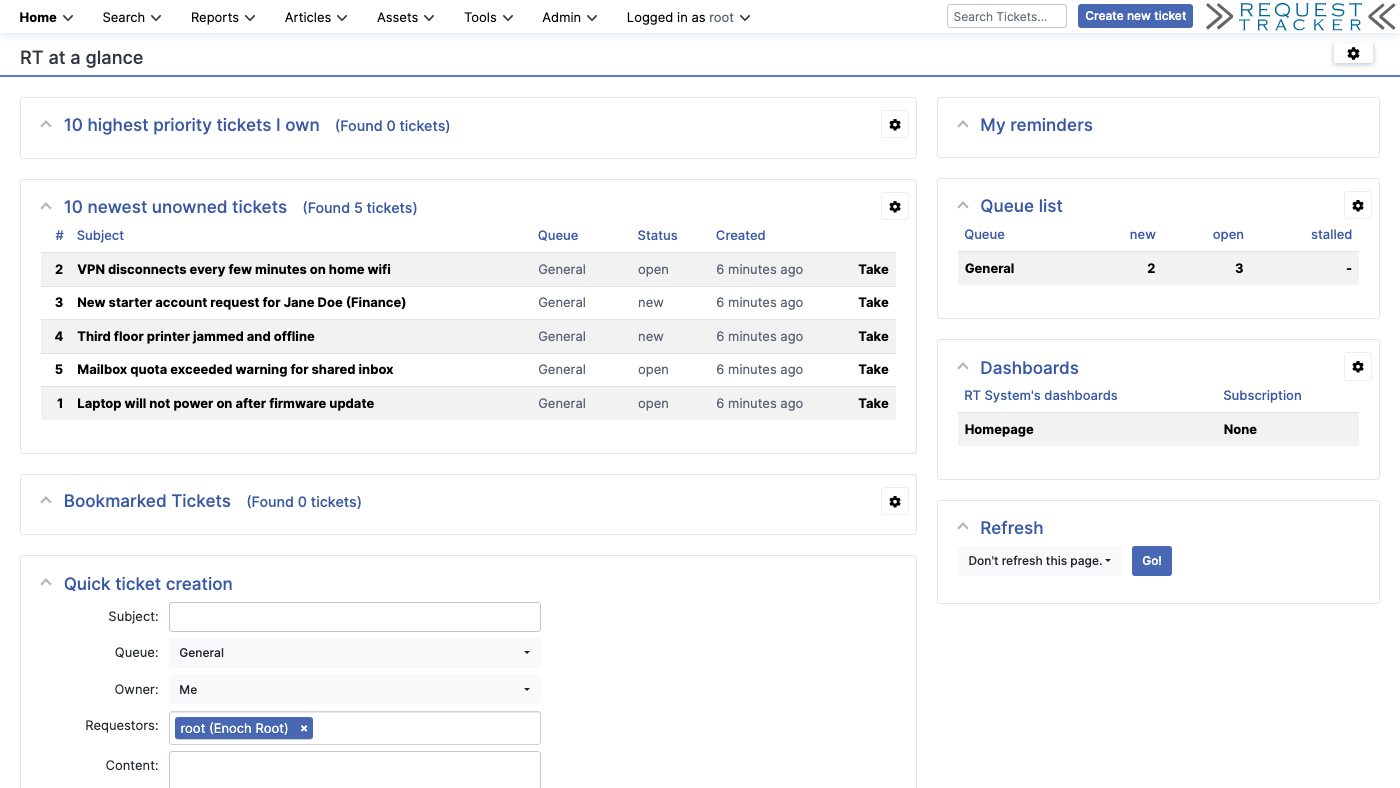
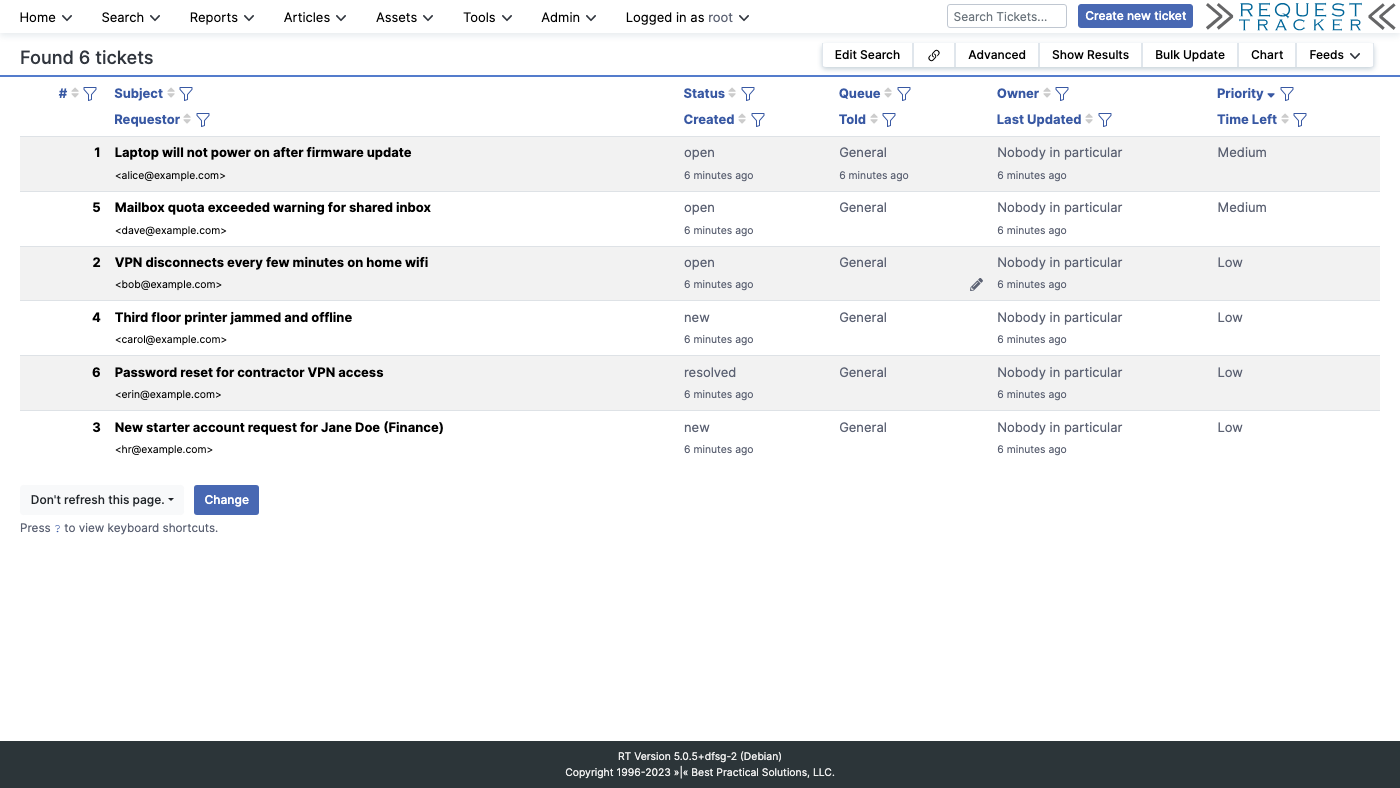
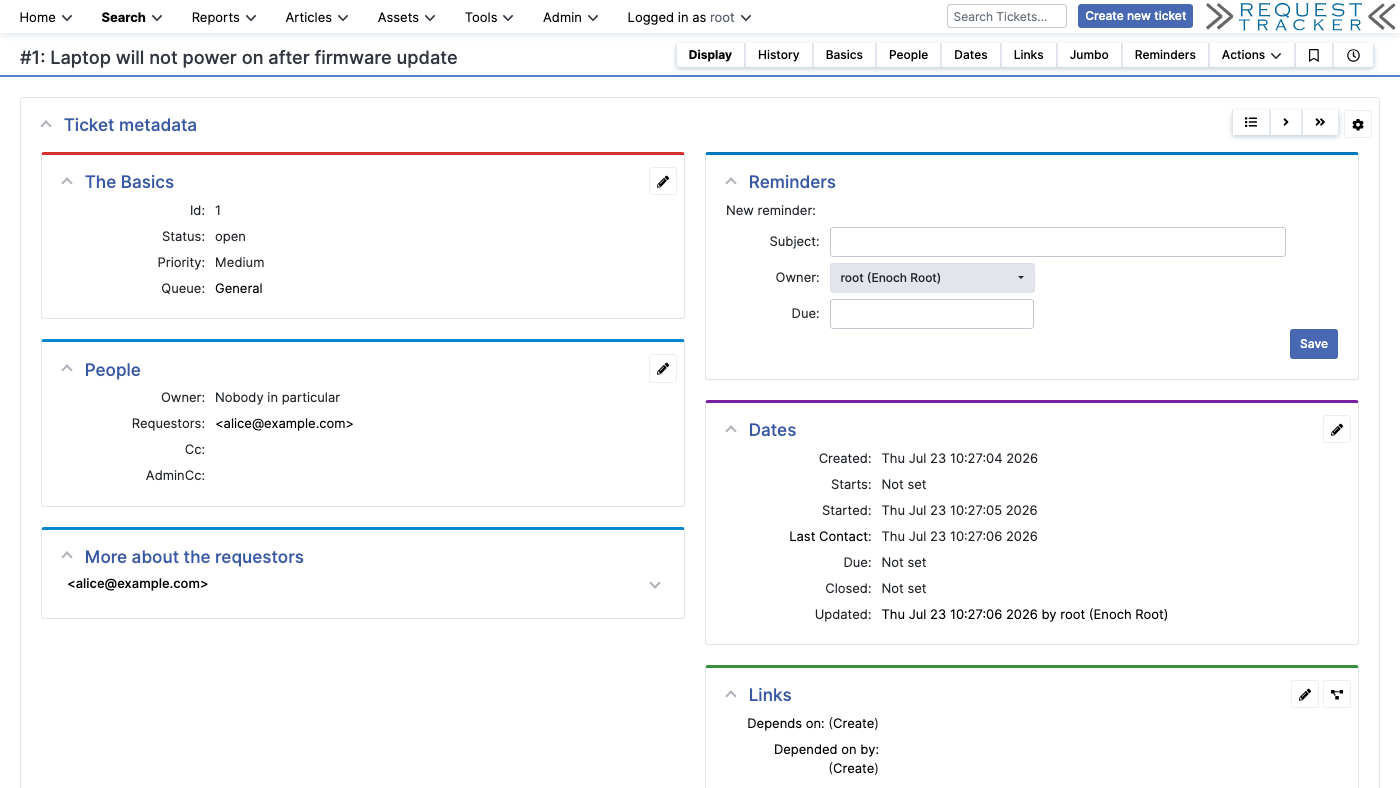
Real screenshots taken while testing this image against its deployment guide.
This is a repackaged open source software product wherein additional charges apply for cloudimg support services.
## Launch a Production Service Desk in Minutes
Request Tracker (RT) is a mature, enterprise-grade ticketing and workflow platform from Best Practical, used across government agencies, universities, ISPs and enterprises for help desks, IT service management, customer support, network operations and incident response. This pre-hardened AMI delivers a fully operational ticketing system within minutes of launch, eliminating the hours of manual dependency resolution, database setup and security configuration that a from-scratch install demands.
## What You Get Without Lifting a Config File
Installing RT by hand means resolving a long chain of Perl module dependencies, standing up and tuning PostgreSQL, initialising the RT schema, configuring Apache with the prefork MPM and mod_perl (RT is not thread-safe), and rotating the well-known default root login before the instance is exposed. This image completes every one of those steps at build time. RT is installed from maintained distribution packages so every Perl dependency is package-managed; PostgreSQL runs bound to the loopback interface only; and the well-known default root password is never shipped.
## Security Hardening - Defence in Depth
## Enterprise Ticketing Capabilities
## Concrete Use Cases
## AWS Integration
Deploy on any EC2 instance type; the recommended starting size is m5.large. Front RT with an Application Load Balancer and terminate TLS with your own ACM certificate. Point RT's web domain at your own hostname. Back up the ticket database using EBS snapshots or AWS Backup. Resize the dedicated data volume independently of the OS disk as your ticket history grows.
## Evaluate Before You Commit
Launch on a smaller instance type such as t3.medium to explore the RT interface, configure queues and test email workflows at minimal infrastructure cost, then scale up to m5.large or larger for production.
## cloudimg Support
24/7 technical support by email and chat. Help with deployment, configuring queues, custom fields, scrips and workflow, wiring up inbound and outbound email, reverse-proxy termination with your own domain and certificate, and backup planning for your ticket database.

This image runs the Actual Budget 26.6 sync server, the open source local-first personal finance and envelope budgeting ...

This image runs Admidio, the open source, self hosted membership management platform used by clubs, associations and non...

This image runs Apache Answer, the open source question and answer platform for teams at any scale.

Apache OFBiz, the open-source ERP, CRM, e-commerce and supply-chain suite, preinstalled and running behind nginx and rea...

This image delivers Audiobookshelf 2.35, the popular open source self-hosted audiobook and podcast media server, fully i...

This image runs Baby Buddy 2.9.2, the open source self-hosted web application for tracking a baby's daily activities and...