Base
Hardened build
minimal ports, security patches applied at build time

A personal wiki and freeform notebook where every note links and transcludes, ready to use behind a unique login on first boot.
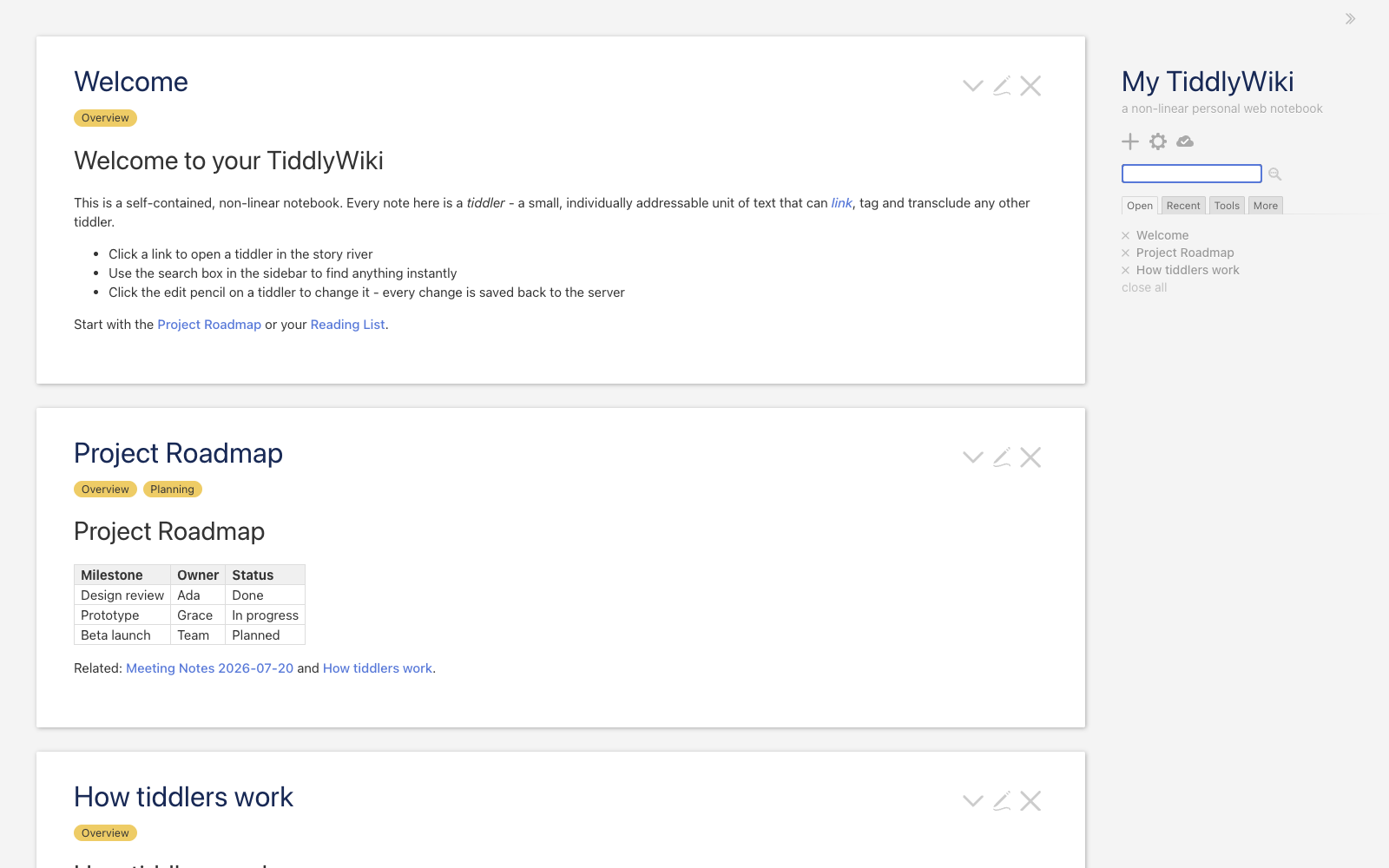
TiddlyWiki is an open source personal wiki and non linear notebook. Content is captured as small, individually addressable notes called tiddlers that link, tag and transclude each other freely, so a knowledge base grows organically instead of as rigid pages. Running as a Node.js server, it saves every change back to the machine, giving individuals and teams a fast, self contained place to keep notes, documentation, task lists and research.
cloudimg delivers TiddlyWiki hardened, fully patched and fronted by a reverse proxy so the wiki loads working over the network. A unique admin password is generated on first boot with no default login, and TiddlyWiki's own built in authentication requires that credential for every read and write. Your wiki content is stored on a dedicated data volume and survives reboots, it ships with a paired deployment guide, and it is backed by 24/7 support.
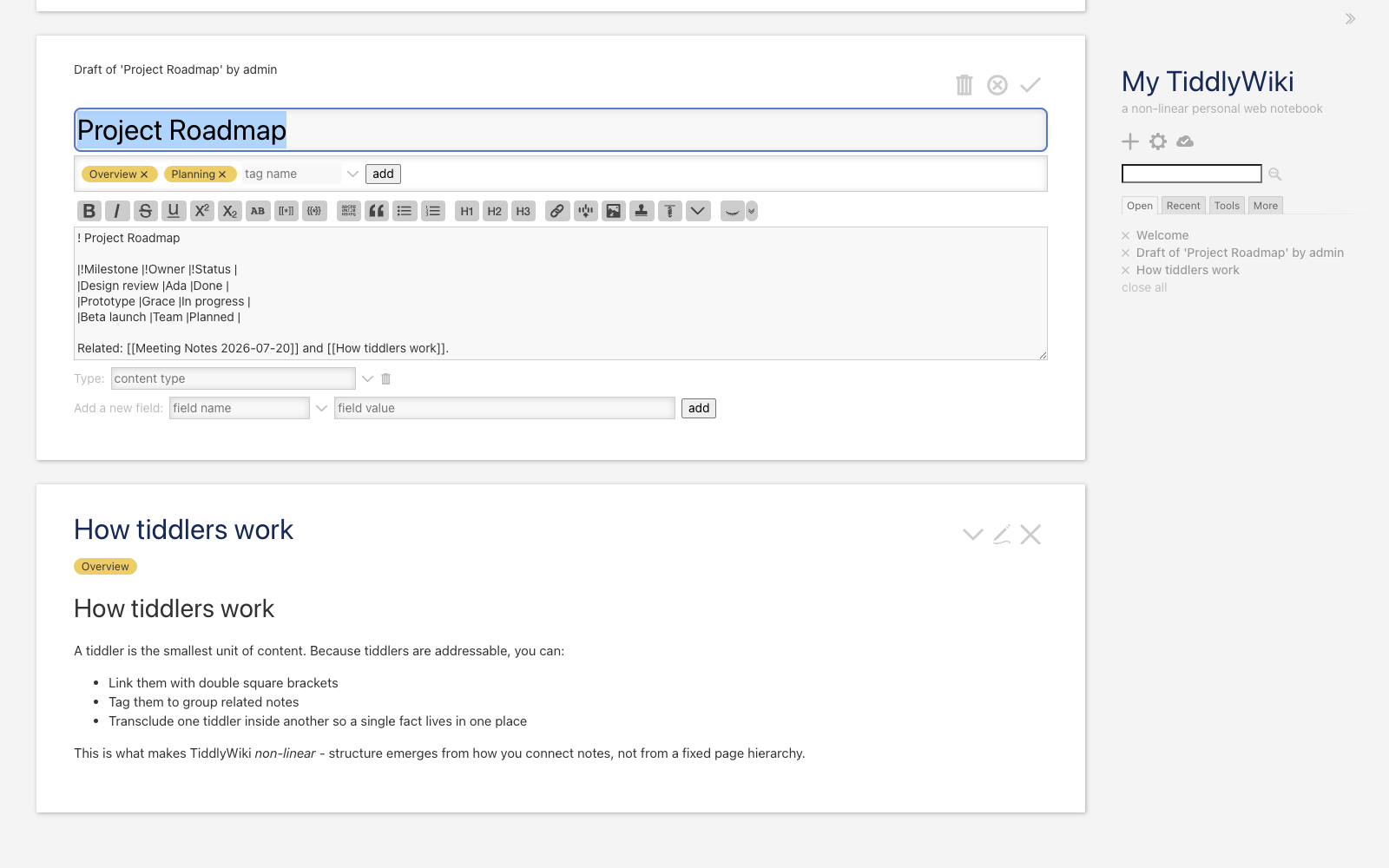
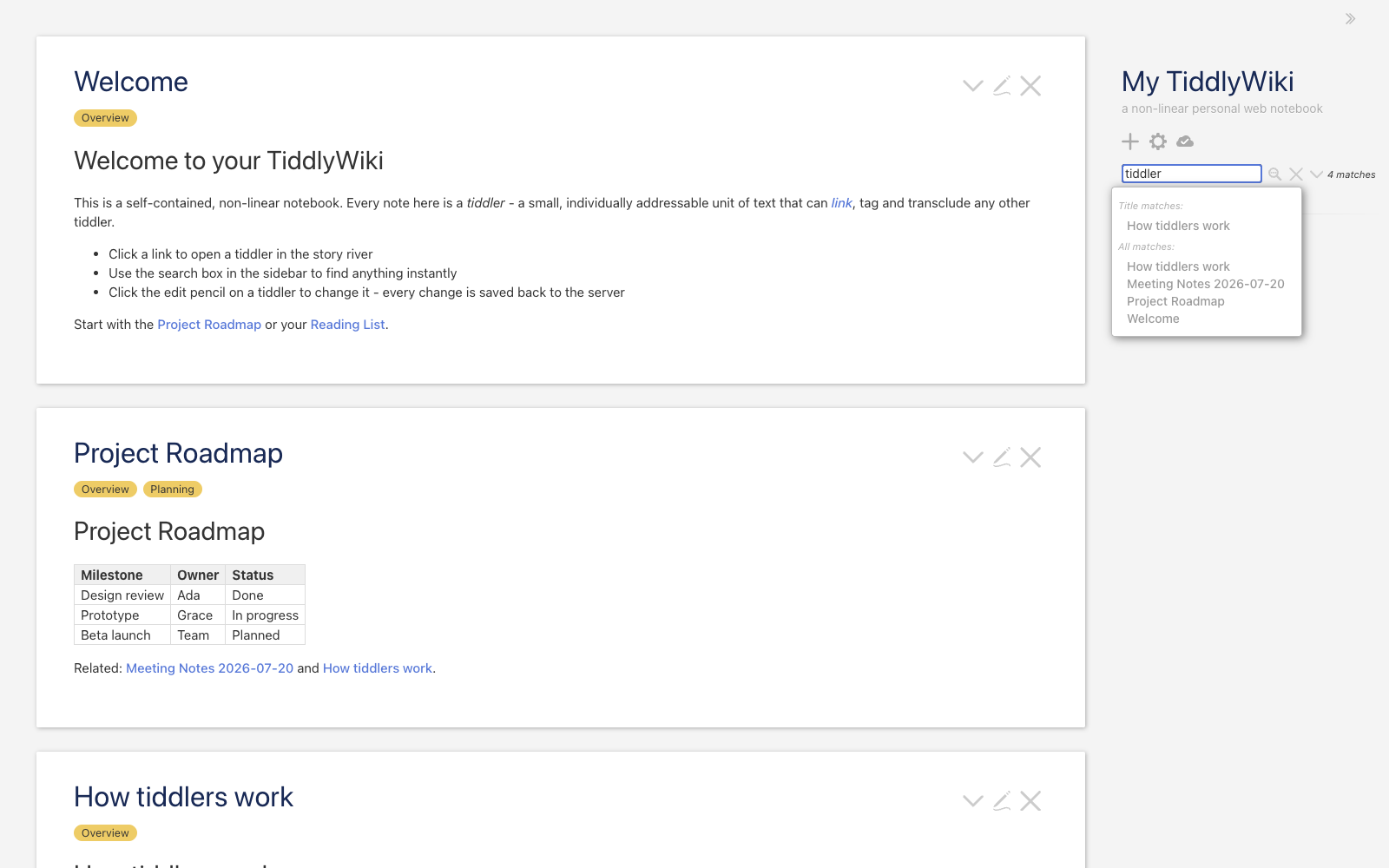
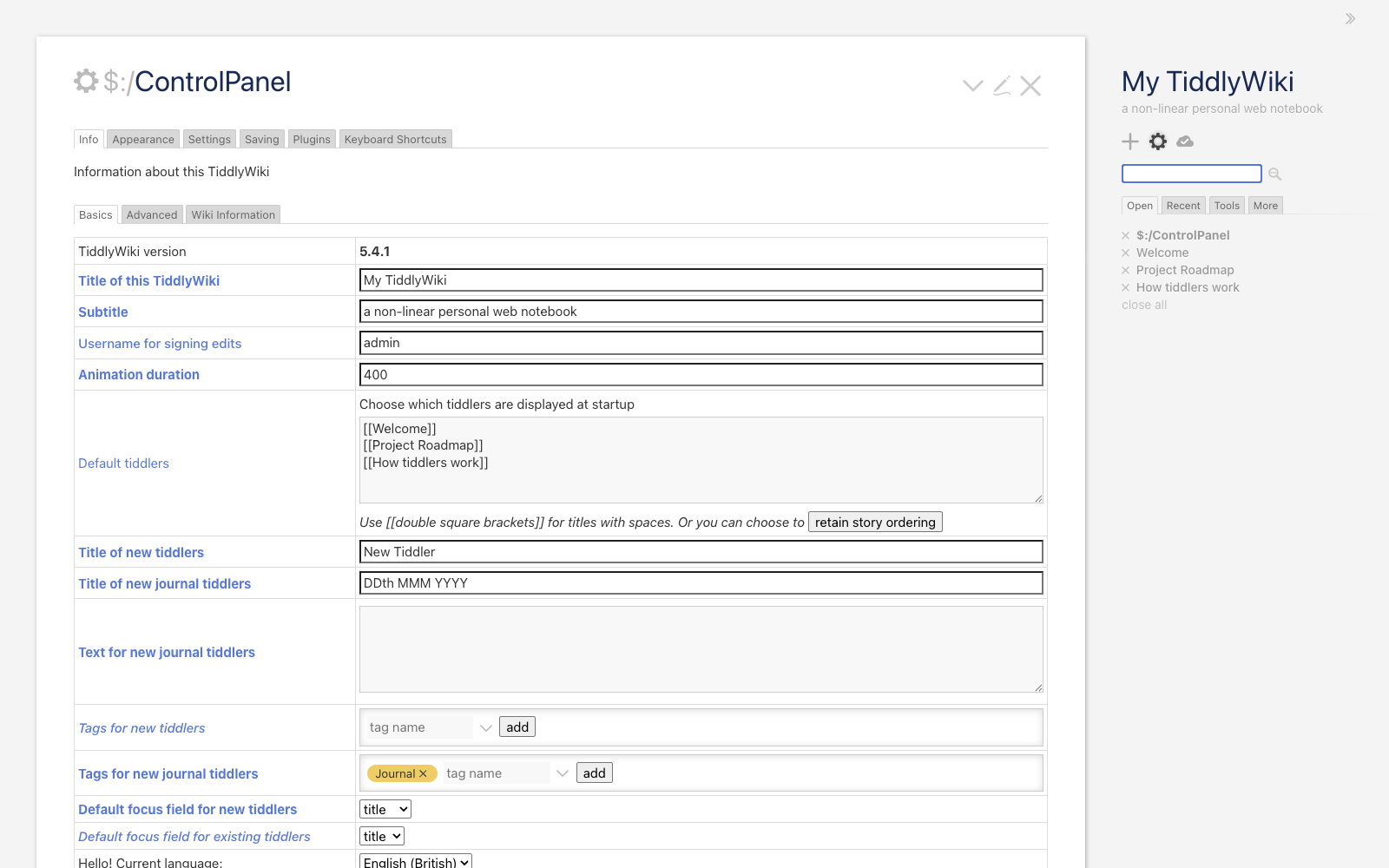
Real screenshots taken while testing this image against its deployment guide.
This is a repackaged open source software product wherein additional charges apply for cloudimg support services.
## Why This AMI Instead of Self-Deploying?
TiddlyWiki is a mature open source personal wiki and non-linear notebook. Content is captured as small, individually addressable notes called tiddlers that link, tag and transclude each other freely, so a knowledge base grows organically instead of as rigid pages. Deploying the Node.js server edition yourself means installing Node.js, configuring npm globally, writing systemd units, hardening nginx as a reverse proxy, generating secure passwords and maintaining the stack over time. This AMI removes that effort entirely - your self-hosted wiki server is running within minutes of launch, not hours, in a pre-hardened, tested configuration backed by 24/7 expert support.
The current release available is TiddlyWiki 5.4.1.
## Application Stack
TiddlyWiki is installed globally with npm on Node.js 22 LTS and run by an unprivileged service account. Its built-in Node server listens on the loopback address and an nginx reverse proxy fronts it on port 80, with a raised upload limit for large tiddlers and attachments. A systemd service starts the server on boot and restarts it on failure. Each tiddler is stored as a file in a server wiki folder, so every change you make in the browser is written straight back to the instance.
Architecture: browser -> nginx reverse proxy on port 80 -> Node.js TiddlyWiki server on the loopback -> file-based tiddler storage on a dedicated EBS volume.
## Secure By Default
Many pre-built images ship with shared or default passwords - a common vulnerability that exposes instances immediately after launch. This image eliminates that risk entirely:
Your wiki content lives on your own instance, on a dedicated data volume, never on a third party's cloud.
## Ready To Use
Browse to the instance on port 80, sign in with the generated admin credential, and start capturing notes - create, link, tag and transclude tiddlers, and every change is saved back to the server wiki folder. Your wiki data lives on a dedicated, independently resizable storage volume kept separate from the operating system disk, so you can grow it without touching the OS. A 7-day free trial lets you evaluate the full stack before you commit.
## What You Avoid By Using This AMI
## cloudimg Support
24/7 technical support by email and live chat. Our engineers help with TiddlyWiki deployment, the built-in authentication model, backups of the server wiki folder, TLS termination and scaling.
## Use Cases
All product and company names are trademarks or registered trademarks of their respective holders. Use of them does not imply any affiliation with or endorsement by them.

This image runs the Actual Budget 26.6 sync server, the open source local-first personal finance and envelope budgeting ...

This image runs Admidio, the open source, self hosted membership management platform used by clubs, associations and non...

This image runs Apache Answer, the open source question and answer platform for teams at any scale.

This image delivers Audiobookshelf 2.35, the popular open source self-hosted audiobook and podcast media server, fully i...

This image runs Baby Buddy 2.9.2, the open source self-hosted web application for tracking a baby's daily activities and...

Baikal is an open source self-hosted CalDAV and CardDAV server built on the proven Sabre/dav library.